
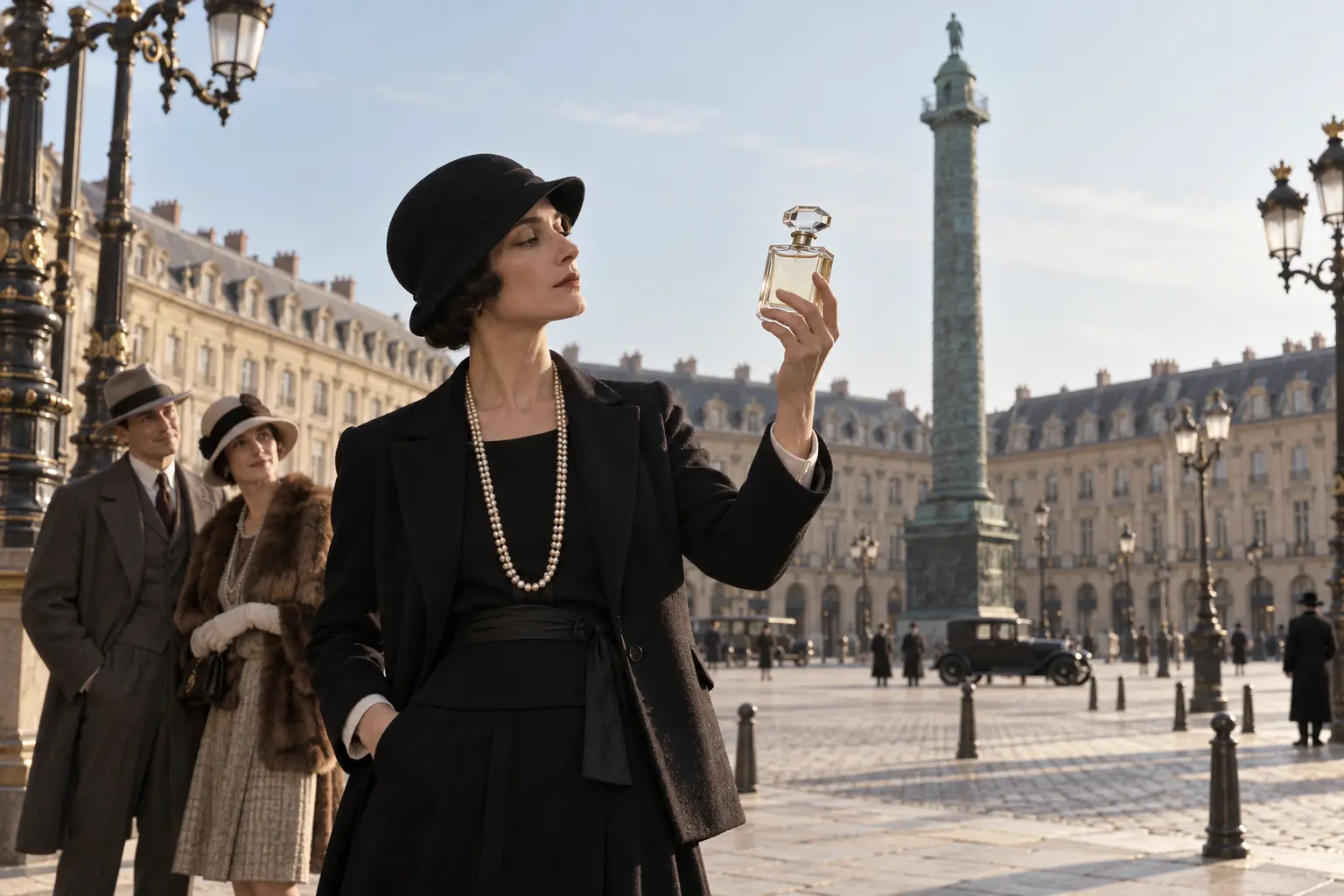
The answer begins by separating the bottle from its stopper
The idea that the Chanel No. 5 bottle reproduces Place Vendôme is irresistible. It immediately connects a world-famous object with a Paris shape that travelers can encounter on foot. Yet that sentence goes farther than the clearest official statement. CHANEL describes the octagonal stopper as borrowing its form from Place Vendôme. The bottle has its own geometry: a rectangular volume, transparency, beveled edges and a restrained label. This distinction does not destroy the story; it makes it possible to look more carefully. In the square, a guest can compare an urban perimeter, cut stone and a small piece of faceted glass without pretending that the entire object is a reduced architectural plan. Precision provides a better method for cultural travel: identify the element that is directly documented, then examine how the House’s visual memory expanded that relationship into a coherent design language.
In 1921, restraint in glass accompanied abstraction in scent
CHANEL dates the launch of N°5 to 1921 and presents it as the result of Gabrielle Chanel’s collaboration with perfumer Ernest Beaux. The fragrance pursued an abstraction rather than the faithful imitation of a single flower. Its container also stood apart from the elaborate bottles commonly associated with prestige perfume. Visual economy did not mean an absence of design. It directed attention toward proportion, clear material and the contrast between a short name and a complex scent. To appreciate the decision, visitors need to resist projecting the familiarity of today’s bottle back onto its first appearance. A simple container could be as assertive as ornament. Our article on how Chanel icons are made explores how repetition, use and public recognition later transform design decisions into cultural symbols. The bottle became inevitable only after people had learned to recognize it.
What CHANEL currently says about the geometry
The House describes N°5 through geometric form, beveled edges and a faceted stopper reminiscent of an emerald cut. In its presentation of N°5 high jewelry, CHANEL explicitly connects the stopper’s octagon with Place Vendôme. That contemporary statement is strong evidence for the visual code the brand claims today. It does not automatically answer every question about the first drawings, the exact date of each adjustment or the words used to describe the object at launch. A careful history separates present-day heritage language from documents produced in 1921. Both matter, but they answer different questions. One tells us how CHANEL transmits its identity now; the other would reveal how the gesture was explained at the time. For travelers, the gap is productive. It opens a discussion about how a fashion house preserves, selects and arranges its memory, and why an inherited shape can become more explicit as later collections reinterpret it.
An icon can change while remaining recognizable
The bottle recognized today has not remained materially identical since its debut. Its silhouette was strengthened, proportions evolved and the stopper changed several times. Continuity through adjustment helps explain its power. The object appears stable because its essential signs remain readable even when manufacturing and distribution require change. Place Vendôme therefore works less like a complete technical blueprint than a memory shape. The octagon can be simplified, thickened or translated into a watch and a jewel without becoming a literal architectural reproduction. For design-minded guests, this distinction is valuable. It frames visual identity as a living system rather than a frozen drawing. A brand does not need every detail to date from day one in order to maintain a meaningful relationship with its Paris setting. What matters is how transformations preserve recognition, and how later designers choose which parts of the inherited vocabulary to repeat, refine or enlarge.
Place Vendôme is both physical architecture and a mental image
The square has a geometry that seems instantly clear, yet a person standing at ground level may not experience its perimeter like a plan. Visitors first notice regular facades, angled corners, the axis of the column and openings into neighboring streets. Aerial and graphic views make the octagon more explicit. The distance between bodily experience and mental image is precisely what makes the N°5 relationship compelling. A small faceted stopper condenses an urban form dispersed around the walker. Reading Place Vendôme through Chanel places that detail within a district of workshops, windows, hotels and movement. The square is not an open-air logo. It has political, architectural and social histories that Chanel memory joins without exhausting. A thoughtful itinerary allows both stories to remain visible: the place retains its complexity while the design connection gives guests a specific reason to examine its angles.
Why the shorthand about the whole bottle persists
A powerful brand story is simple, visual and easy to retell. Saying that a bottle came from Place Vendôme creates a perfect scene: Gabrielle Chanel looks at Paris and turns the city into an object. Actual design histories usually combine more references, prototypes, glass constraints, production decisions and distribution needs. The shorthand persists because it gives the public an immediate connection among person, place and form. There is no need to mock it; its limits simply need to be restored. The best-supported relationship concerns the octagonal stopper. The rest is a wider visual affinity that became increasingly coherent over time. This method avoids two opposite errors: repeating a legend as total proof or believing that historical nuance eliminates the cultural value of the association. Once located and labeled, a legend becomes an excellent observation tool. It invites guests to ask exactly which lines correspond, and which similarities arise from the story they already know.
Connecting Rue Cambon, the Ritz and Place Vendôme with care
Chanel memory in Paris forms a network of addresses that visitors may be tempted to merge into an automatic itinerary. Rue Cambon relates to the House’s work; the Ritz has its own hospitality history and a place in Gabrielle Chanel’s biography; Place Vendôme offers an architectural and symbolic setting. Their proximity does not mean that every interior is accessible or included in one service. Rue Cambon and the origins of Chanel’s Paris world helps preserve the role of each location. A travel advisor should confirm access, reservations and opening conditions separately. That accuracy makes the day more elegant. Stops do not accumulate famous names; they answer successive questions about creation, urban life, hospitality and the translation of a Paris form into a recognized object. Walking distance provides continuity, while careful interpretation prevents geography from being mistaken for commercial inclusion.
Offer guests a visual inquiry rather than a final secret
For travelers interested in fashion, fragrance or design, the strongest promise is not the revelation of a single hidden answer. It is learning how to compare. In the square, guests can observe the octagon, axes and facets, then consider how an object reduces architecture to a few signs. Elyrea’s Coco Chanel Encounter can embody the tensions among Gabrielle, the House and Paris without presenting interpretation as archival speech. A useful brief notes the group’s expertise, interest in fragrance or couture and the other visits planned that day. This angle works particularly well for repeat visitors because it makes a celebrated square active again: Place Vendôme becomes a question rather than a backdrop. Guests can leave with a nuanced answer. Yes, Place Vendôme belongs to the geometric language of N°5. No, the entire bottle should not be described simply as a glass model of the square.
FOR YOUR GUEST ITINERARIES
Planning Paris for guests interested in fashion, fragrance or design? Elyrea can help you weave this reading of Place Vendôme into their journey.
Discuss your itinerary