
Champagne was still evolving
The champagne familiar to travelers today depends on practices that developed and improved over time. At the start of the nineteenth century, fermentation, deposits, handling and transport presented significant challenges. Modern consistency should not be projected backward as something producers already took for granted. This context gives Madame Clicquot's contribution its meaning: the house participated in making a complex wine easier to prepare and present reliably. The innovation belongs to a changing production system, not a single miraculous invention.
What fermentation left behind
Fermentation in the bottle produces sediment. Left dispersed through the wine, it affects clarity and creates a practical challenge for a producer seeking an attractive, dependable product. Removing it also raises questions about efficiency and loss. A traveler can understand the issue without a detailed chemistry lesson: the desired clear glass required an organized way to move and eliminate material that the process of making the wine had generated. Production and presentation were therefore closely linked.
What riddling actually does
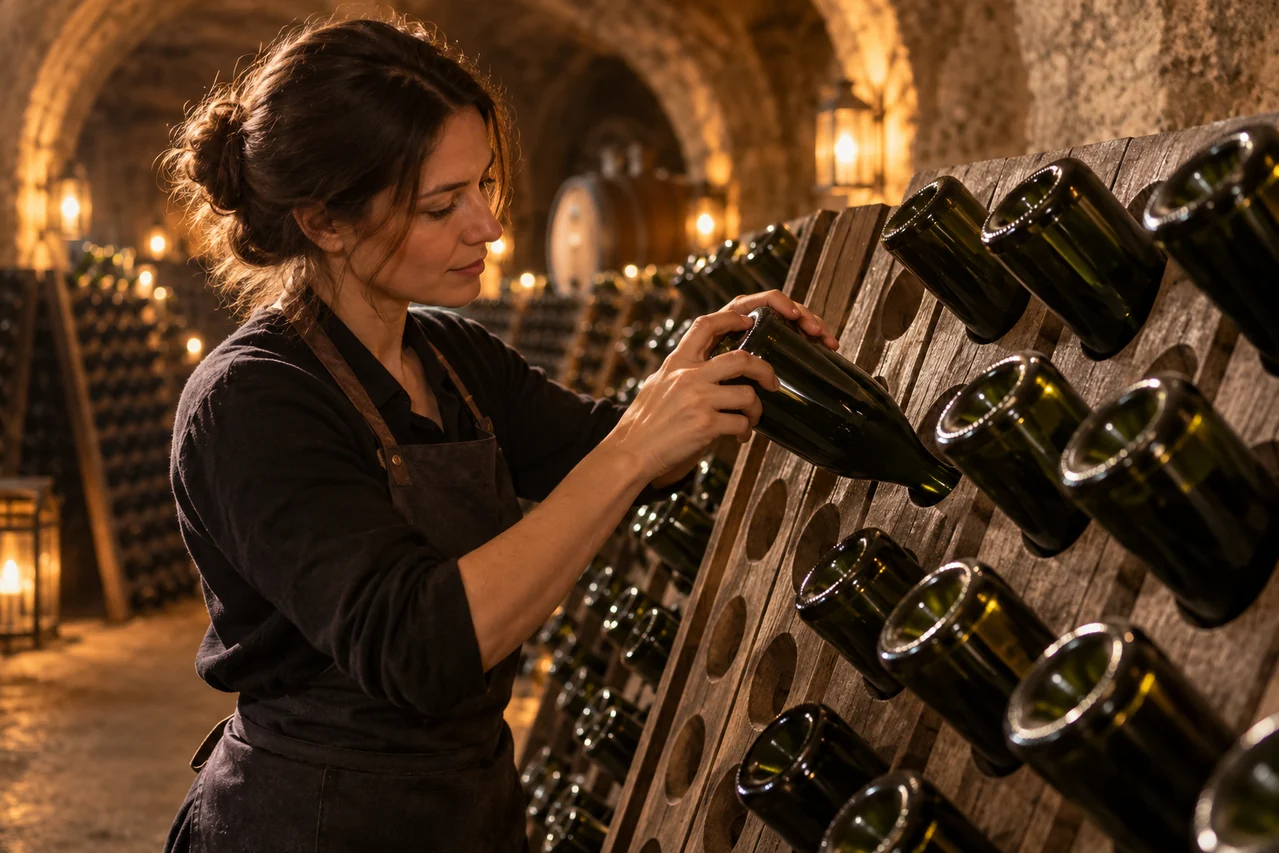
Riddling gradually changes the position of bottles so the sediment moves toward the neck. Once gathered there, it can be removed during disgorgement. The two stages should not be confused: riddling prepares the deposit for removal; it does not itself remove it. This simple sequence makes the contribution tangible for non-specialists. It also explains why looking at a wine's clarity can become a historical observation, connecting a visible quality with work that usually remains out of sight.
Why Clicquot is associated with the process
Madame Clicquot and her house are closely connected with developing and refining riddling in the early nineteenth century. The familiar story of a pierced table helps illustrate the arrangement of bottles, but it should not replace the broader explanation of the problem being solved. Nor should every practical gesture be credited to a leader working alone. Skilled people and the house's operational knowledge were part of the innovation. Her role is meaningful without erasing the collaborative nature of production.
A production improvement becomes a commercial advantage
Clearer wine and a more effective process could support the house's reputation and capacity to supply markets. That connection is central to Clicquot's business strategy: quality was not separate from commercial ambition. A recognized product required more than an attractive name. Explaining production also changes how travelers understand luxury, drawing attention to consistency, labor and technical judgment. The glass becomes evidence of an achieved result rather than simply a sign of expense or prestige.
Do not confuse contribution with invention
Champagne's development involved many producers, workers and evolving practices. It would be inaccurate to turn Madame Clicquot into the sole inventor of sparkling wine or suggest that everything recognizable today originated with her. Strong historical storytelling gives a person a defined contribution within a collective story. This approach is more satisfying than an exaggerated superlative because readers can understand exactly what changed and why it mattered, while remaining aware that techniques continued to evolve beyond her lifetime.
Look differently during a tasting
A guest can begin by observing clarity before moving to aroma, texture and freshness. The historical explanation gives that first observation an unexpected dimension. It does not mean a visual impression alone establishes quality or tells the complete production history of a particular bottle. A thoughtful approach to tasting champagne connects attention with questions, allowing participants to learn without pretending to evaluate every technical detail. The historical narrative supports sensory experience instead of taking it over.
Follow the technique back to a person
Innovation gains emotional force when it connects with the choices of a recognizable figure. A Tasting with Veuve Clicquot brings the production story into a performed encounter with Madame Clicquot, while distinguishing theatrical interpretation from archival evidence. Her biography supplies the social and commercial context behind the familiar name. For advisors, this creates a useful cultural thread between a Paris encounter and a Champagne journey, without implying a specific venue, cellar access or tasting selection that must be confirmed separately.
FOR YOUR GUEST ITINERARIES
For guests curious about the work behind champagne, ask Elyrea how a narrative tasting can connect production, innovation and Madame Clicquot's business story.
Discuss your itinerary