
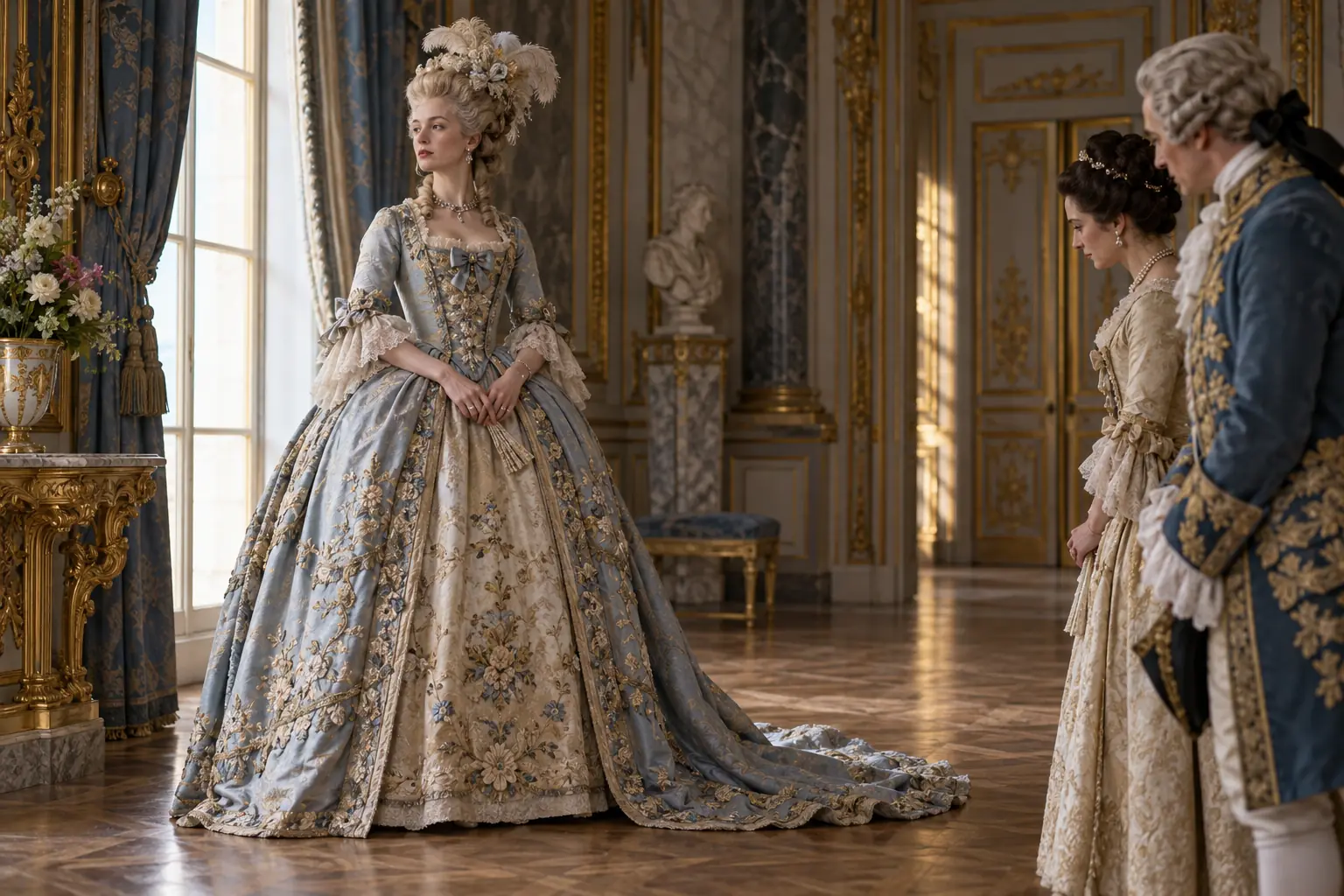
At Versailles, dress established where a person belonged
Court clothing did more than decorate an individual whose authority already existed. It helped make rank visible. Silhouette, textile, ornament, hair and the occasion for which a garment was chosen told observers how a woman belonged within the hierarchy and what kind of room she was entering. For the queen, dress had to create a legible presence in a palace where proximity to the sovereign was continually watched. Marie Antoinette’s identity alone was not enough; she was expected to appear as queen through a language the court understood. That representation demanded labor, expense and artistic skill, but it also served a political purpose. It directed attention and reaffirmed the distinctions on which Versailles operated. Reading a court gown therefore means reading a social architecture of distance, access and ceremony—not simply judging whether its wearer had extravagant taste.
Silhouette organized the space around the queen
Panniers that extended a skirt sideways did not merely follow fashion. They changed movement, required negotiation with doorways and made the wearer conspicuous within an assembly. A robe à la française, with its structured bodice, decorated front and pleats falling from the shoulders, offered a broad surface on which textile and workmanship could be displayed. Hidden supports—stays, petticoats and shaped understructures—produced the expected outline. Museum conservation demonstrates how much an eighteenth-century gown’s meaning depends on restoring those volumes rather than hanging surviving silk on a flat form. Yet no single dress defined every hour of royal life. Ceremony, setting, time of day and changing fashion all altered what was appropriate. Court clothing becomes most revealing when treated as a flexible system with rules, not as one spectacular uniform frozen in time.
Getting dressed could itself become an exercise of power
Royal rising and dressing rituals staged access to the sovereign body. The people admitted and the actions they were permitted to perform depended upon rank and etiquette. The queen’s toilette should therefore not be imagined as routine domestic service. To attend, assist or hand over part of the clothing could signal a person’s place within an authorized circle. Dress connected the intimate with the political. It also helps explain why Marie Antoinette valued more private spaces, particularly at Trianon, where she could step away from some court formality. Withdrawal was not politically neutral. Courtiers whose own status depended on access could experience her privacy as exclusion. The queen’s desire for personal freedom and the aristocracy’s fear of losing proximity could be produced by the same decision. Clothing rituals expose that tension more clearly than a simple list of gowns ever could.
Rose Bertin and the network behind a royal image
Marie-Jeanne Bertin, better known as Rose Bertin, became an important supplier and creative partner in Marie Antoinette’s wardrobe. Later memory has often called her the “Minister of Fashion,” a phrase that expresses her influence but should not be mistaken for an official title. Her career reveals fashion as a network. Textile makers, embroiderers, milliners, merchants, hairdressers and workshop labor all contributed to the appearance attributed to one famous client. The queen did not invent each novelty alone, though her visibility could accelerate imitation. That relationship also made personal taste inseparable from public representation. Innovation might advertise French craftsmanship and luxury production; it could also feed criticism of a foreign-born queen portrayed as wasteful. Clothing became political because it placed economy, gender, image and authority on a surface that almost anyone could recognize and discuss.
The chemise gown scandal made simplicity politically dangerous
In 1783, Élisabeth Vigée Le Brun exhibited a portrait of Marie Antoinette in an informal white muslin gown, often called the robe en gaulle or chemise à la reine. The image provoked outrage and was replaced at the Salon by a more conventional portrait. Apparent simplicity did not remove symbolic power. Some viewers believed the Queen of France should display the material signs of her position; others read the garment as unacceptably intimate. In a kingdom invested in silk manufacture, imported-looking muslin could raise another concern. The episode demonstrates that no wardrobe strategy was safe. Magnificence could be attacked as excess, while simplicity could be condemned as undignified, artificial or economically disloyal. Marie Antoinette’s clothing mattered not because every choice followed one political plan, but because the queen inhabited a system in which every departure from expectation could be interpreted against her.
Caricature turned fashion into political accusation
The Queen’s wardrobe did not cause the monarchy’s financial crisis or the French Revolution. Claiming that it did would repeat the logic of pamphlets that isolated her body and spending as convenient symbols. Fashion nevertheless provided vivid material for hostile politics. Exaggerated hairstyles, rumored bills, luxury and foreign birth could be combined into stories about corruption and national betrayal. Marie Antoinette’s gender and Austrian origins intensified the particular violence of those attacks. Separating documented expense from reputation and caricature helps travelers understand the politics of image without forcing a verdict of innocence or guilt. It also extends the question explored in why Marie Antoinette became so widely hated. Dress is most useful here not as gossip, but as evidence of how legitimacy, monarchy and the public role of women were contested.
Use clothing to read the spaces of Versailles
This history changes what a traveler can notice in an antechamber, doorway or portrait. Room scale, sequence and visibility mattered to bodies shaped by court dress and to a society organized around controlled access. The visitor should not assume that every space retains precisely the arrangement or use it had in the late eighteenth century; present decoration, historical change and later restoration must remain distinct. Clothing becomes one interpretive key: who could see the Queen, from where, during which ritual and through what signs of rank? A Marie Antoinette day at Versailles becomes more coherent when architecture, portraiture and conversation answer the same question. The gown then appears not as an isolated object but as something that acted upon the body, the room and the political gaze simultaneously.
Meet the character without confusing presence with proof
A professional actress embodying Marie Antoinette can make these tensions tangible: the wish for privacy, the obligation to be seen, delight in style and the impossibility of escaping judgment. Her first-person voice remains a dramatic interpretation grounded in historical work, not an archive speaking or a total reconstruction of Versailles. Marie Antoinette, Rebel Queen connects the personality with a place central to her story without implying unconfirmed availability, pricing or palace admission. For travel advisors, the theme suits fashion-minded guests, families with teenagers and clients who want to move beyond the stereotype of a frivolous queen. Contact Elyrea with the party profile to position the Encounter within a private itinerary while confirming tickets, hours, mobility and estate services separately.
FOR YOUR GUEST ITINERARIES
Designing Versailles for clients interested in fashion, history or power? Elyrea can help place this reading of royal representation within their journey.
Discuss your itinerary