
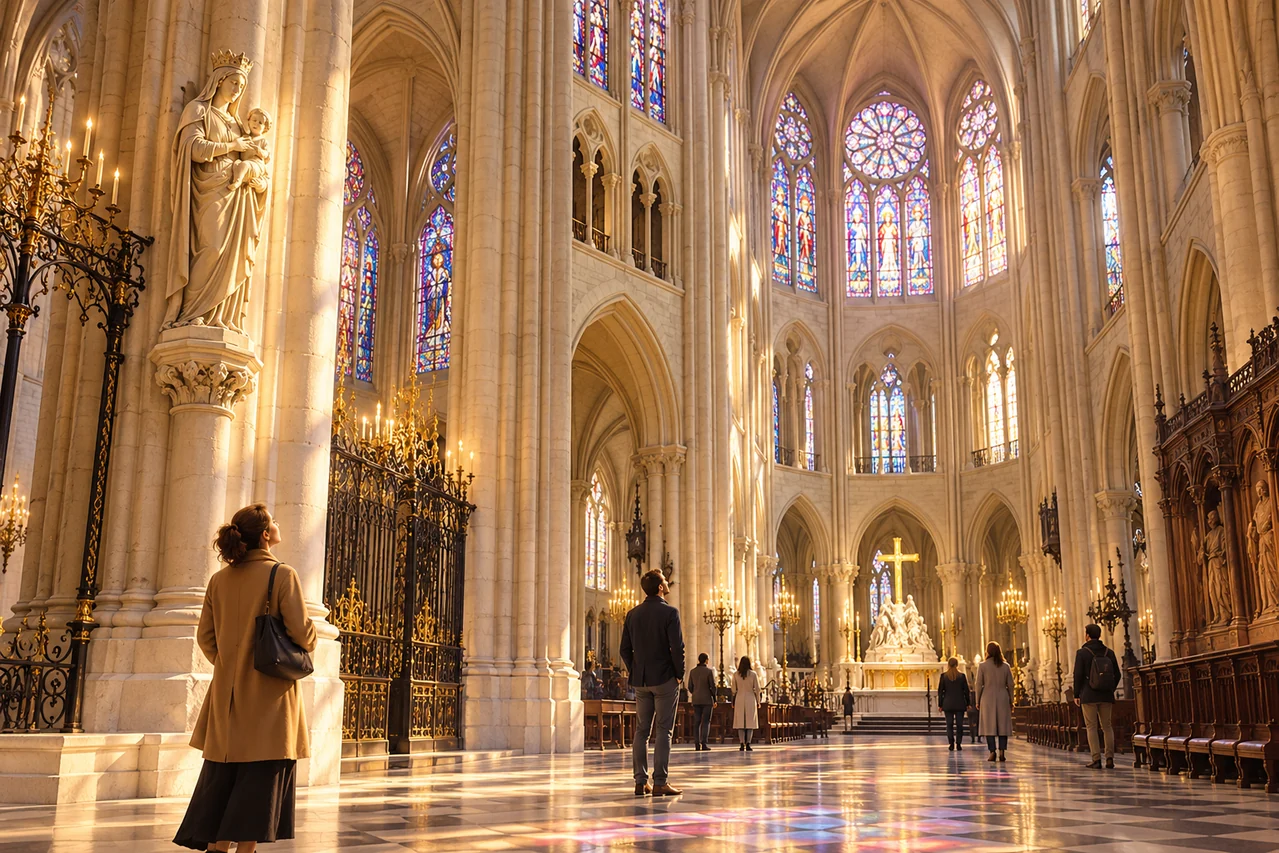
Return with a new question rather than an old checklist
For visitors who knew Notre-Dame before the fire, returning can become a comparison between memory and the restored building. What do they notice now, and what did they overlook before? The restoration has given the monument another chapter, so the purpose of the visit need not be to repeat a general history already heard. First-time visitors also benefit from a clear question: how does a medieval cathedral continue to change while remaining recognizable? These approaches make the visit more attentive. They invite travelers to consider continuity, rather than treat reopening as a simple reset that removed every trace of the event and subsequent work.
Tell the fire's history without making catastrophe the attraction
On 15 April 2019, a major fire destroyed the roof and spire and caused significant damage to Notre-Dame. The event and its international impact are part of the monument's history, but a cultural itinerary should not depend on dramatic repetition of images of destruction. The response matters as well: securing, studying and restoring the building required sustained work. Explaining those tasks moves the story toward understanding rather than spectacle. Visitors can acknowledge the loss and emotion without being trapped within them. The cathedral's renewed presence then becomes an opportunity to examine the care and knowledge that made its survival possible.
Use restoration to reveal specialized craft
The restoration brought together architectural study, engineering and a wide range of skilled trades, including work on stone, timber, glass and roofing. For travelers interested in French craftsmanship, that collaboration offers a substantial subject in its own right. The comparison with couture lies in dependence on expertise and practiced gestures, not in treating a religious monument as a luxury product. The work behind haute couture provides a different setting for the same question about invisible labor. Notre-Dame helps visitors see that heritage relies on living knowledge, with many contributors whose work cannot be captured by the name of one famous architect.
The spire makes historical layers especially clear
The reconstructed spire follows the design associated with Viollet-le-Duc's nineteenth-century intervention. This creates a useful surprise for visitors who assumed the familiar spire was entirely medieval. A later addition had become a defining part of the cathedral's cultural image and therefore something people wished to transmit. The restoration shows that heritage value can accumulate around interventions as well as around original fabric. That does not make every later change identical in significance. It encourages a more precise way of looking: what period does an element belong to, and how did it become important to the building people recognize?
Place Hugo between medieval Notre-Dame and its later restorations
Hugo's novel appeared in 1831 and contributed to attachment toward the cathedral within a wider concern for medieval heritage. It preceded the major nineteenth-century restoration, but should not be presented as its sole cause. Hugo's contribution to preserving Notre-Dame distinguishes cultural influence from practical action. This makes literature part of the monument's history rather than an optional decorative story added to it. The cathedral was not simply seen, described and then left unchanged. The ways people imagined it helped shape why they cared about it, while public decisions and expert work determined how that care became material intervention.
Esmeralda connects imagination with a changing monument
Esmeralda is a fictional character from a nineteenth-century novel set in 1482. Meeting her around a cathedral restored in the twenty-first century therefore brings several periods into conversation. The encounter can make those layers intelligible through a recognizable voice, provided it does not confuse literary perspective with a historical witness account. A traveler looks at an actual building while considering the imagined world associated with it. The cathedral as Hugo's literary character helps explain why this combination is so durable. Fiction has not replaced Notre-Dame's history, but it has become part of the experience through which millions of people approach that history.
Distinguish first-time visitors from returning guests
Returning travelers may have personal memories and photographs that shape what they notice. Their questions can guide an itinerary that honors those memories while adding new understanding. First-time visitors need orientation among medieval origins, nineteenth-century changes and the restoration after 2019. Neither audience benefits from pretending the monument belongs to a single untouched period. The advisor can establish their interests before choosing how much architectural, literary or craft content to include. Any planned cathedral entry needs current practical arrangements checked separately. The cultural purpose of the itinerary should be clear without inventing admission conditions, special access or an experience inclusion not confirmed by the relevant team.
Make the island a sequence of distinct chapters
A wider Île de la Cité day can include other histories through Sainte-Chapelle, the Conciergerie or a literary perspective associated with Poe. Those additions should follow the guest's interest rather than the convenience of nearby buildings. Esmeralda keeps Notre-Dame and Hugo central; another chapter can deliberately change period or tone. Choosing between Esmeralda and Poe helps preserve that distinction. The reopening is not the end of the cathedral's story. It is a reminder that heritage remains active, interpreted and cared for, and that a familiar monument can offer new discovery when the visitor learns to see its different histories together.
FOR YOUR GUEST ITINERARIES
Do your guests want to rediscover Notre-Dame after its reopening? Elyrea can help you place the Esmeralda encounter within an itinerary connecting the restored cathedral with its literary and historical layers.
Discuss your itinerary