
A celebrated machine with no surviving original
The mechanical lion attributed to Leonardo da Vinci is famous in spite of an incomplete material record. No original automaton survives, and no comprehensive drawing lets engineers reproduce it component by component. Later tradition supplies the memorable sequence: a lion advanced, reared and opened its chest to reveal lilies. The story is plausible within Renaissance court culture, but its details do not all carry equal evidentiary weight. Responsible interpretation must hold wonder and caution together. The machine probably belonged to a world of ceremonial invention, while the exact arrangement of its gears and motions remains open to informed reconstruction.
Lyon in 1515: greeting a victorious young king
The usual setting is Francis I’s ceremonial entry into Lyon in 1515 after the victory at Marignano. The city, its merchants and the Florentine community had strong reasons to honor the new king. A lion could represent Lyon, strength and Florentine identity; lilies immediately signaled the French monarchy. The automaton was therefore more than an engineering demonstration. It condensed civic welcome, political loyalty and Italian prestige into a staged surprise. The Metropolitan Museum connects a lion automaton with the king’s formal visit. That account supports the occasion while still leaving room for uncertainty about the exact choreography later writers described.
Why attach Leonardo’s name to the lion?
Leonardo had extensive experience designing court festivals, stage effects and machines in Italy. His notebooks reveal sustained interest in gears, programmed movement and the management of visual surprise. An animated lion fits that professional world. Contextual fit, however, is not the same as a complete construction dossier. Later sources, including the account associated with Vasari, played a major role in shaping the legend. Leonardo’s final years in Amboise explains why Francis I valued a creator whose usefulness crossed painting, architecture, mechanics and ceremonial imagination. The lion represents that broad reputation more securely than it documents every technical detail.
How could a lion have walked?
Modern reconstructions test combinations of springs, cams, gears and timed triggers. They show that a fully mechanical sequence was feasible using Renaissance knowledge and craftsmanship. They do not establish that Leonardo’s machine used the same arrangement. The Politecnico di Milano emphasizes the scarcity of technical information and treats its reconstruction as an engineering investigation. A contemporary model should therefore be read as a physical hypothesis. It clarifies problems of weight, balance, stored energy and synchronization while making visible how much interpretation is required. The experiment adds knowledge when it declares its assumptions instead of presenting them as recovered certainty.
Lilies turned mechanism into message
The opening chest is the narrative center of the performance. Surprise converted a heraldic animal into a vehicle for royal homage. The lion could address the city and Florentine patrons, while the lilies celebrated Francis I. Several identities met in one carefully timed action. This symbolic density explains why spectacle mattered as much as mechanics. A court invention was judged not only by whether it worked, but by whether it produced wonder at the proper moment and made a political relationship visible. The engineer choreographed collective emotion. Gears, casing, music, procession and audience formed one diplomatic medium rather than separate technical and artistic domains.
An automaton is not a modern robot
Calling the lion a robot may make the story approachable, but it can also create false expectations. The device had no electronic sensors, adaptive intelligence or modern autonomy. It would have executed a sequence arranged in advance through stored mechanical energy and controlled releases. That limitation does not diminish the achievement. It places the lion within the longer history of automata, where the illusion of life depends on timing, concealed machinery and skilled fabrication. As with Leonardo’s urban ambitions at Romorantin, the interest lies in joining technical thought to public purpose rather than in projecting present-day technology backward.
Reconstructions expose our own expectations
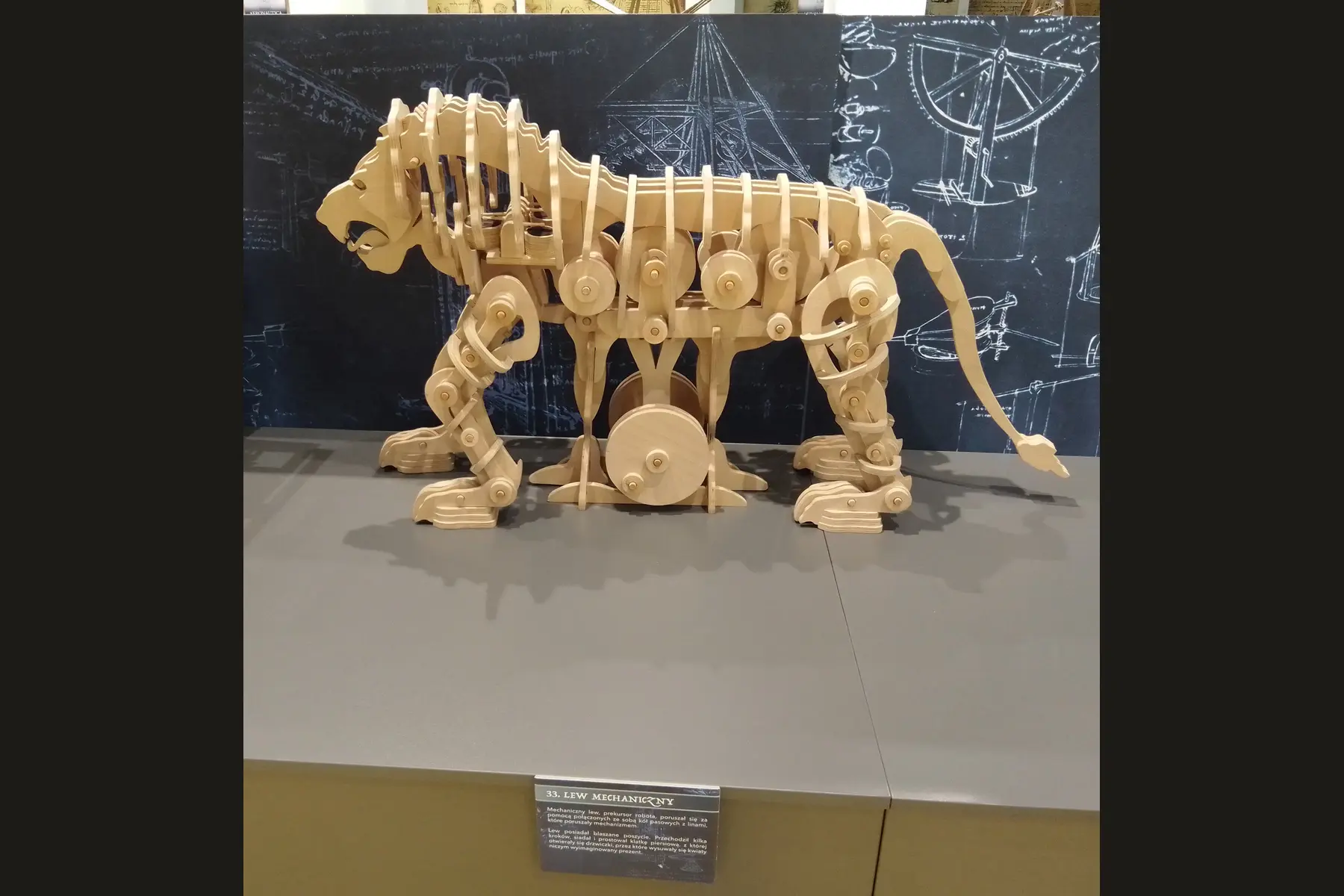
Every modern builder must fill gaps in the evidence. Material, gait, posture and the opening mechanism reflect contemporary interpretation as well as historical possibility. The image accompanying this article shows a modern wooden reconstruction, not a surviving object made by Leonardo. Saying so strengthens the encounter. Viewers can separate what sources attest, what engineering makes plausible and what a reconstruction team had to invent. That process is central to the history of technology. A model becomes most useful when it makes an argument visible and preserves the limits of that argument, allowing the public to examine uncertainty rather than hiding it behind an impressive performance.
B2B guidance: present the court as a laboratory
For travel advisors, the mechanical lion opens a Renaissance world in which artists, engineers, merchants and diplomats collaborated. The Elyrea Encounter devoted to Leonardo da Vinci can begin with the spectacle, unpack its symbols and then test the mechanisms that may have made it possible. The narrative should distinguish later testimony, attribution, technical knowledge and modern reconstruction. A comparison with Gustave Eiffel as engineer and scientist can reveal how public performance shapes an inventor’s memory. Precision turns a marvelous anecdote into a richer interpretation of power, patronage and designed wonder.
FOR YOUR GUEST ITINERARIES
Planning a Leonardo-focused journey in France? Elyrea connects machines, court culture and diplomacy in a private Encounter.
Discuss your itinerary