
The queen was not merely in the audience
At Trianon, Marie Antoinette commissioned productions, listened to contemporary music and performed with a restricted circle of relatives and friends. The idea can feel startling because official queenship seems incompatible with amateur acting. Yet private theatricals were an established aristocratic practice in the eighteenth century. Participants read, rehearsed, sang and distributed roles beyond the daily ceremonial order. For Marie Antoinette, the stage offered a temporary shift in identity: she was not only the sovereign being watched but a player responding to other players. The freedom was privileged and carefully bounded. It nonetheless illuminates her repeated effort to escape court etiquette—and the impossibility of ever leaving politics entirely behind.
Richard Mique designed a hidden theater
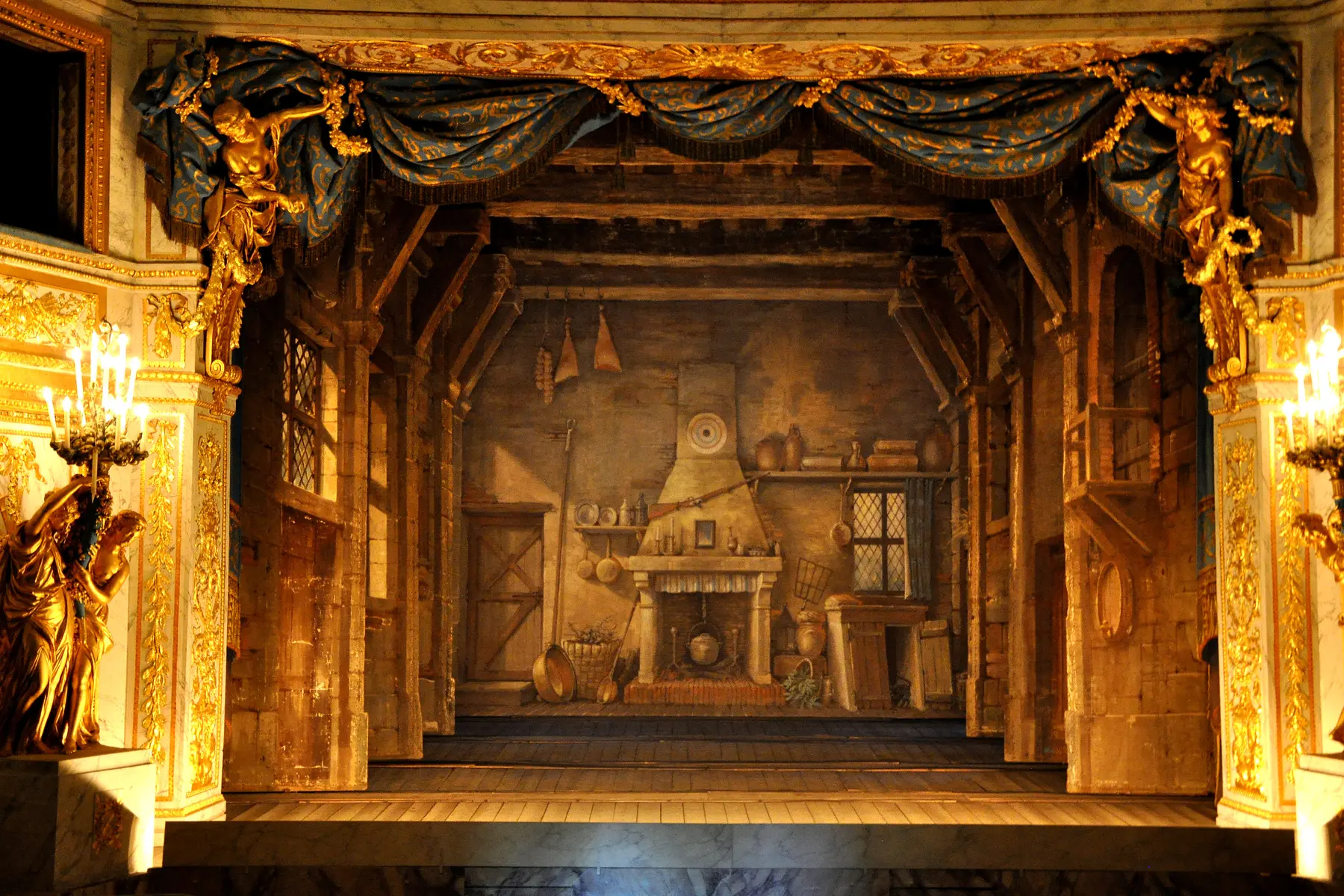
Tired of temporary stages in the Grand Trianon gallery and the Petit Trianon orangery, Marie Antoinette asked her architect Richard Mique for a permanent theater. Work was completed in spring 1780 and the building opened on June 1. Its exterior is deliberately discreet among the gardens. Inside, blue, white, gold, imitation marble and papier-mâché create a sophisticated world of illusion. The room could hold about 250 spectators, while the stage used advanced machinery. This contrast between a modest shell and a spectacular interior expresses the logic of Trianon: retreat was never simple but carefully designed. Why Marie Antoinette loved the Petit Trianon finds its most theatrical architectural answer here.
One building, two kinds of performance
Versailles describes a deliberate double purpose. The theater could receive artists from the Royal Academy of Music and provide the equipment required for productions commissioned by the queen. It also supported théâtre de société, the private performances in which Marie Antoinette and her circle assumed the roles. Both uses continued from 1780 to 1785. Music by Gluck, Grétry, Sacchini and Paisiello appeared there, revealing an informed engagement with the contemporary stage rather than an empty whim. The building nevertheless concentrated substantial resources on a chosen audience. That tension among artistic curiosity, pleasure and privilege explains why the theater can be admired as an extraordinary survival while still being read as a political space.
A troupe of relatives and friends
Marie Antoinette formed an amateur company with the Comtes de Provence and d’Artois, the king’s brothers, and members of her intimate circle. Louis XVI attended the company’s first performance in August 1780 before a limited audience. The queen sang and acted as Colette in Jean-Jacques Rousseau’s Le Devin du village. In August 1785, during her final appearance on this stage, she played Rosine in Beaumarchais’s The Barber of Seville. The contrast between public identity and chosen characters is revealing: young women shaped by theatrical love, wit and freedom. It would be excessive to treat the roles as a conscious political declaration. Yet the pleasure of inhabiting another condition points toward what court life denied her.
Playing at privacy under the court’s gaze
The theater felt private, but nothing in a queen’s life could remain entirely so. Admission signaled closeness; exclusion could produce resentment and rumor. Expenses, rehearsals and casting became material for commentary. A refuge designed for intimacy therefore contributed to an image of a sovereign enclosed by favorites. The paradox runs throughout Trianon. The Queen’s Hamlet would likewise be interpreted as a search for freedom or proof of blindness. The theater establishes neither absolute frivolity nor modern rebellion. It shows how Marie Antoinette’s personal tastes could never be separated from the political meanings attached to every royal gesture by Versailles and the wider public.
The room exposes the mechanics of illusion
The stage had eight scenic planes, two levels below and two overhead, while the orchestra pit could accommodate around twenty musicians. Materials imitate rather than merely display: gilded papier-mâché, false marble, perspective effects and moving scenery created magnificence through the craft of the Menus Plaisirs. The image used here was made during a partnership between Versailles and Wikimedia France; it documents the preserved room, not a performance by the queen. Restored historic machinery makes the theater an exceptional survival of eighteenth-century stagecraft. Reading it as a machine for transforming reality also offers a metaphor for court life, where appearances were regulated, places assigned and every observer trained to interpret signs.
When an intimate image becomes public reputation
Marie Antoinette sought a more personal sphere at Trianon, but her choices fed a reputation she could not control. Theater joined clothing, portraiture and the hamlet in a struggle over interpretation. How Vigée Le Brun tried to repair the queen’s image shows an explicitly public maternal response to criticism. The stage offered no comparable campaign, yet acting itself became grounds for judgment. Marie Antoinette abandoned the theater after 1785. The building survived the Revolution without major damage and later underwent restoration and occasional use. Its preservation lets visitors encounter more than a decorative curiosity: it is one of the rare places where the queen tried, however briefly, to select her own role.
B2B guidance: let the person prepare the palace
For international advisors, the Queen’s Theater provides a compelling lens before or after a Trianon visit. It brings architecture, music, sociability and public opinion into one narrative without reducing Marie Antoinette to familiar caricature. The Elyrea Marie Antoinette Encounter at Versailles can establish the necessary tension: a woman seeking play and intimacy, a queen whose leisure became political, and a building where stage illusion echoes court performance. An itinerary should not promise access to a particular room or event unless separately confirmed. Its value lies in the interpretive key guests receive, allowing a hidden theater to explain as much about Versailles as its largest official chambers.
FOR YOUR GUEST ITINERARIES
Elyrea connects the Queen’s Theater to Marie Antoinette’s search for privacy, preparing a more human and nuanced encounter with Versailles.
Discuss your itinerary