
A famous gesture that was never uniquely Napoleonic
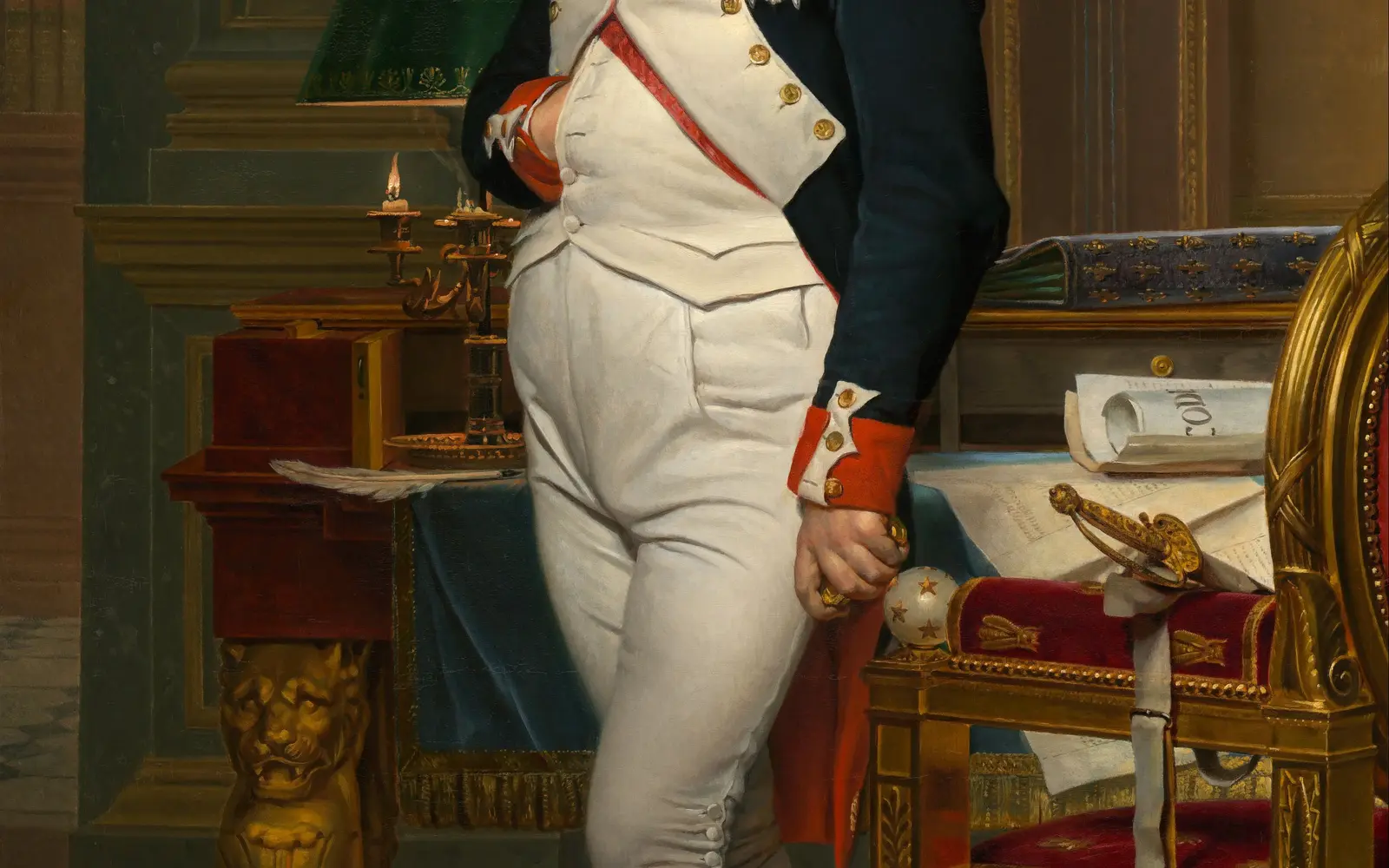
The silhouette feels instantly recognizable: uniform, direct gaze and a right hand inserted between the buttons of a waistcoat. Yet the National Gallery of Art stresses that the pose was not unique to Napoleon. It belonged to a much older vocabulary of Western portraiture. Its association with the emperor arose through repetition, not through an unusual bodily habit.
The medical explanations are unsupported
Popular stories claim that Napoleon concealed a deformed hand or pressed his stomach to relieve pain. Such theories are attractive because they turn a painted detail into a private clue. There is no firm documentary basis for them. In David’s portrait, the position functions as a representational code. Napoleon’s bulletins and public image show how repeated signs can feel more persuasive than archival evidence.
The pose reaches back to classical rhetoric
The National Gallery of Art connects the posture to an ancient tradition: the Greek orator Aeschines treated speaking with the arm contained under a garment as proper conduct. Early modern manuals of bearing and elite portraiture revived that classical ideal. A restrained hand suggested a restrained speaker. The body visibly communicated that impulse, emotion and authority remained under control.
David presents a measured ruler
In The Emperor Napoleon in His Study at the Tuileries, completed in 1812, Jacques-Louis David shows the emperor standing with his hand in his vest. The museum explains that the pose conveyed nobility and composure. Its meaning gains force from the face and setting: Napoleon looks tired, his hair is untidy and the room records a long night of work, yet the central gesture still declares command.
The room turns posture into political narrative
The hand works with burnt-down candles, a clock showing 4:15 a.m., scattered papers and a copy of Plutarch. This is not a candid glimpse of office life. David constructs an argument: the calm body at the center controls an environment dense with decisions. Napoleon’s coronation image likewise demonstrates how gestures and objects could stabilize a preferred reading of imperial power.
Napoleon probably did not sit for this likeness
The National Gallery of Art notes that Napoleon probably never posed for the painting. David, no longer in close favor, drew on visual memory, earlier studies and established conventions. That distinction matters. The image does not necessarily record an everyday behavior. It produces a politically convincing likeness designed to be readable by a patron and a wider audience.
Repetition created a recognizable identity
The Fondation Napoléon explains that the hand in the waistcoat, like the bicorne or Guard uniform, helped viewers identify the emperor across very different scenes. A shared portrait convention became personally Napoleonic through sustained use. The mechanism resembles branding: a small set of coherent signals travels across media, accelerates recognition and survives even in caricature.
B2B guidance: teach guests to read the portrait
For history-focused clients, first ask what the hand appears to communicate, then reveal the pose’s wider history. Contrast bodily calm with the evidence of an all-night working session. This replaces a medical myth with active visual analysis. The Elyrea Napoleon Encounter can extend that inquiry into strategy, image and authority, subject to separately confirmed availability.
FOR YOUR GUEST ITINERARIES
With Elyrea, learn to read Napoleon’s public image as a political language built from gesture, objects and deliberate staging.
Discuss your itinerary