
Chanel's modernity has a prewar setting
Much of Chanel's early influence developed during the first decades of the twentieth century, when women's activities and clothing were changing. Her use of jersey, restrained lines and references to masculine dress belongs within that wider transformation. It would be misleading to describe her as an isolated inventor of modern womanhood. Her strength included recognizing needs and giving them a distinctive form. Chanel's contribution to women's dress explains those material and social relationships beyond familiar slogans about freedom.
Dior's first collection answered another moment
Dior's first collection in February 1947 came after the shortages and restrictions of the Second World War. The silhouette later known as the New Look emphasized softened shoulders, a strongly defined waist and fuller skirts using substantial fabric. Its impact depends partly on that contrast with recent austerity. The historical setting should remain visible rather than becoming a generic story of timeless femininity. Dior's proposal was a particular intervention into postwar life and expectations, not merely a richer version of what came before.
Compare how clothing treats the body
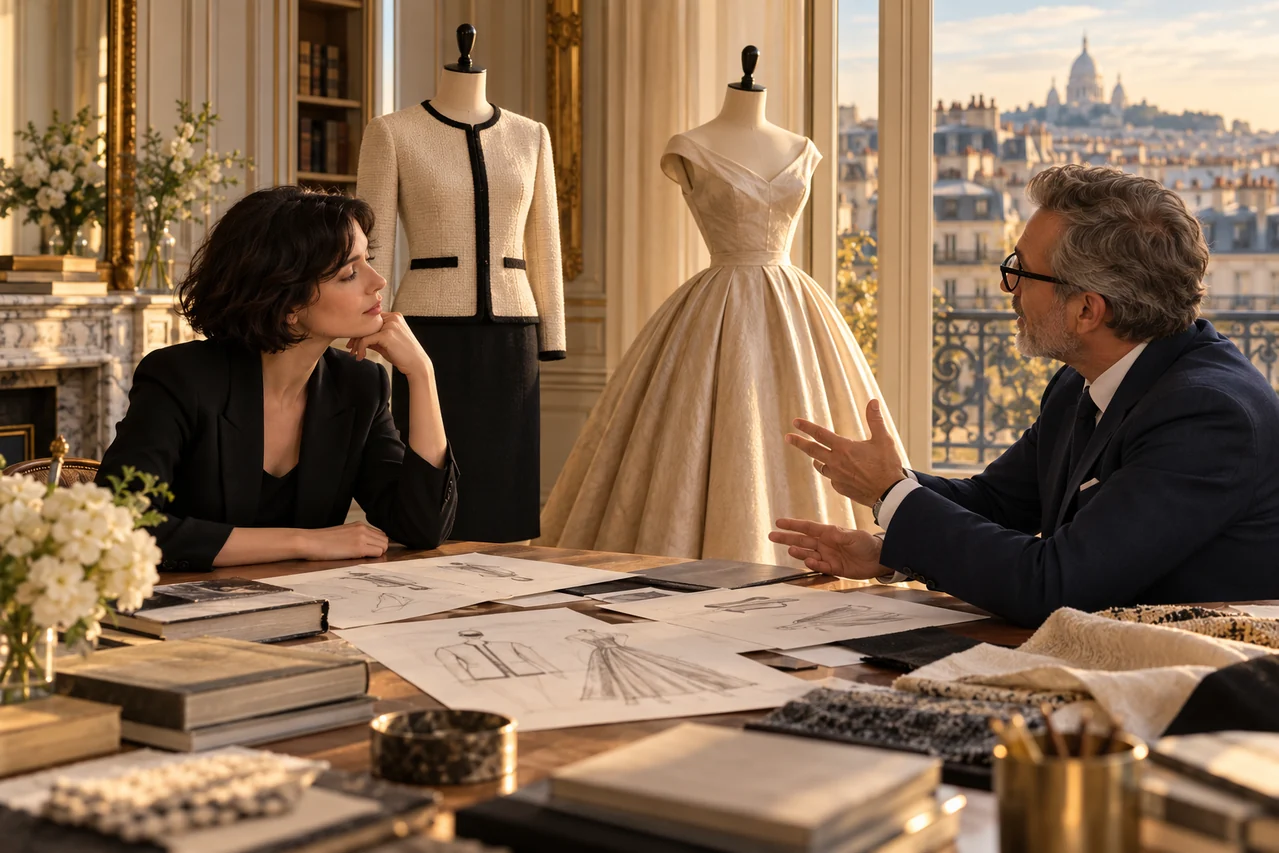
Chanel is associated with approaches that accommodate movement and reduce the feeling of a garment dominating its wearer. Dior's New Look presented a more emphatically constructed silhouette. These tendencies create useful questions about how dress organizes the body in space. They should not become absolute descriptions of every creation across each career. Guests can look at proportion and movement, recognizing that clothing expresses a view of life while remaining shaped by materials, technique and the particular occasion for which it is made.
Visible simplicity and visible abundance both require skill
A restrained line may involve exacting construction, just as a dramatic silhouette depends on careful making. Comparing the houses should therefore avoid assuming that Chanel is effortless or that Dior's complexity is only decoration. Both open a discussion of labor and judgment behind appearance. Their apparent contrasts give visitors a reason to look closely. The most interesting question is often not which object looks more luxurious, but how different visual effects are achieved and why they appealed in their historical settings.
A disagreement is more useful than a verdict
Chanel criticized the direction represented by Dior's silhouette and later returned to couture in a changed fashion landscape. Her return in the 1950s brought renewed judgment rather than automatic acceptance, with international reception playing an important role. That history complicates the idea of stable fame. A cultural comparison can preserve disagreements without declaring a winner. The visitors' own questions about comfort, display and elegance become part of the discussion, rather than a test of loyalty to one famous house.
Paris turns the comparison into geography
Rue Cambon and the Dior world associated with Avenue Montaigne give the two histories distinct urban settings. The Chanel Mystery in Paris ends at Place Vendôme, in front of the Vendôme Column, before a further fashion chapter can shift period and perspective. Dior's postwar Paris supplies that continuation. Advisors should account for movement between neighborhoods and confirm actual arrangements, rather than compress different stories into an uninterrupted route or promise access to places not included in the format.
Extend the theme without losing it
Marie-Antoinette can introduce an earlier system of court dress and public image, while Veuve Clicquot moves outside clothing to explore how product and reputation become international cultural identities. Chanel and Clicquot's different careers help explain that broader connection. Such additions are useful on a longer stay when the theme remains clear. They should not turn the itinerary into an inventory of famous French names whose biographies and industries are treated as interchangeable examples of prestige.
Make shopping a possible continuation of understanding
After considering the founders, silhouettes and city, browsing can take on another meaning. Guests recognize codes and ask how they are being interpreted now. The contemporary houses, however, reflect many later creators and should not be treated as direct illustrations of every founder's intention. For advisors, a Chanel–Dior sequence offers a flexible cultural framework that can appeal to specialists, families or repeat visitors. Its strongest outcome is a richer conversation about fashion's changing relationship with society, rather than a single answer about elegance.
FOR YOUR GUEST ITINERARIES
For fashion-focused guests, Elyrea can help connect the Chanel and Dior Encounters into an itinerary that explores contrasting visions of elegance and the city behind them.
Discuss your itinerary