
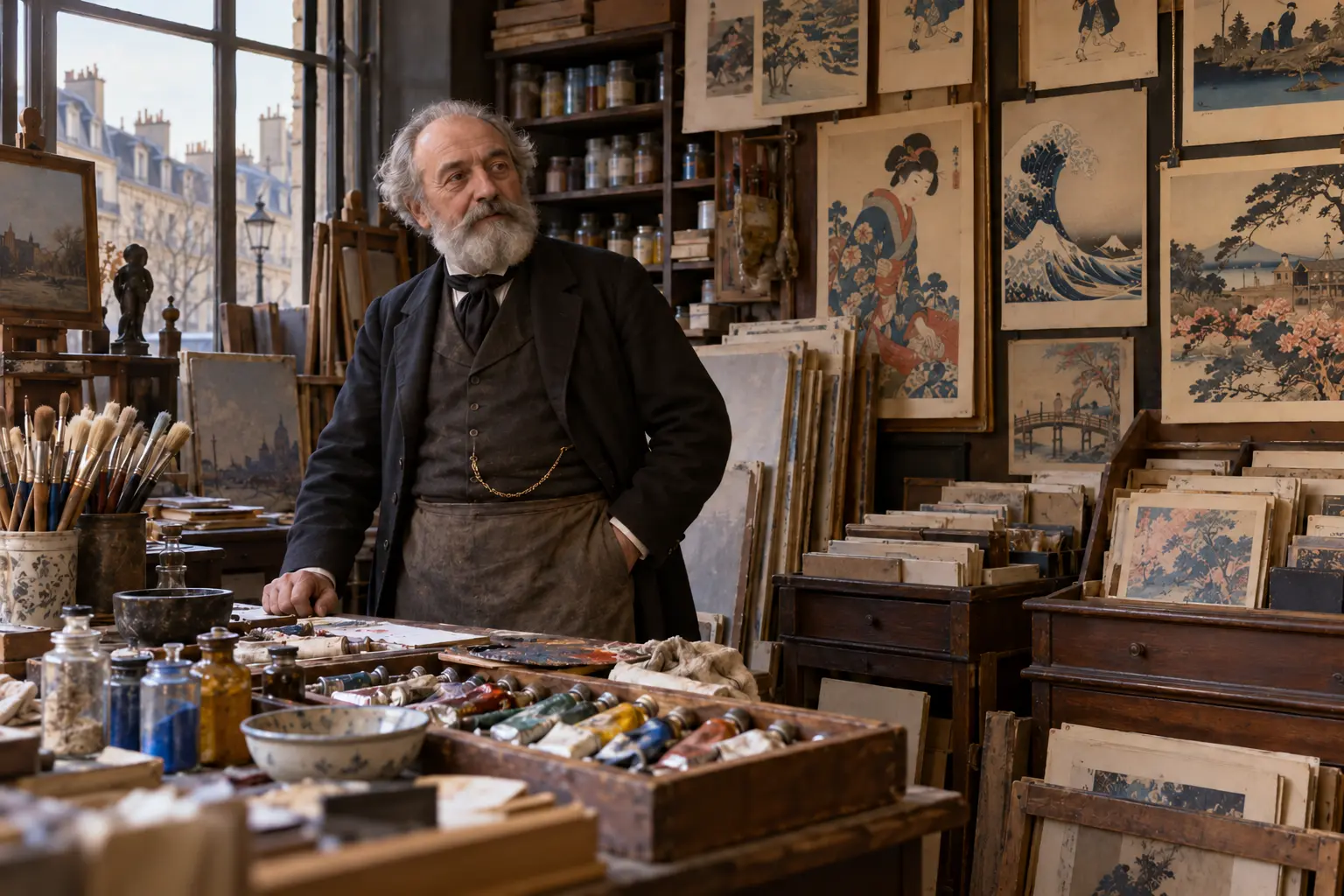
A portrait that maps the circulation of art
Vincent van Gogh’s 1887 Portrait of Père Tanguy places Julien Tanguy at the center of a nearly continuous wall of Japanese prints. The sitter is often remembered as the kindly color merchant who supported painters when money was scarce. Yet the background invites a broader reading. Tanguy appears where painting supplies, contemporary canvases and images from Japan met in late nineteenth-century Paris. The prints are more than exotic decoration; they point to a major shift in how European artists constructed space, color and narrative. Still, the painting should not be turned into a tidy origin story. Tanguy did not single-handedly introduce ukiyo-e to the city. His shop was one node within a much larger network of dealers, collectors, exhibitions, publications and artists. Its importance lies precisely in that everyday power to bring materials, pictures and conversations into contact.
The practical role behind the affectionate name
Julien-François Tanguy, born in Brittany in 1825, worked as a color grinder and later sold artists’ supplies. “Père Tanguy” was an affectionate name that reflected the trust he inspired among painters. He provided tubes, canvas and practical support, sometimes accepting works in payment when young artists had little cash. The arrangement filled his modest premises with paintings that official markets had not yet embraced. Cézanne, Pissarro, Gauguin and Van Gogh all belong to the shop’s story, although it would be misleading to describe it as a formal salon governed by one aesthetic program. Tanguy’s influence was material and relational. He made continued work possible and allowed pictures to be seen in unexpected company. Our account of paint dealers and the making of modern art explores why such commercial intermediaries deserve a place beside artists in the history of innovation.
Ukiyo-e before it became a European artistic language
Ukiyo-e, broadly translated as “pictures of the floating world,” encompassed Japanese woodblock prints depicting actors, celebrated beauties, landscapes, urban pleasures and famous stories. Their circulation in Europe expanded after Japan’s mid-nineteenth-century opening to international trade. In Paris, prints appeared through specialized dealers, collectors, exhibitions and illustrated publications. Their European reception was selective rather than neutral. Sheets were separated from series, certain designers were privileged, and images made for particular Japanese audiences acquired new meanings in drawing rooms and studios. Japonisme therefore describes both genuine admiration and a process of reframing. Recognizing this complexity makes the art more interesting, not less. A traveler can ask what a print originally represented, how it was produced and why an artist in Paris noticed a particular feature. The answer moves beyond the vague idea of “Japanese influence” toward a history of objects crossing markets, languages and systems of value.
What Van Gogh learned by looking at Japanese prints
The Van Gogh Museum explains that Vincent and Theo assembled a substantial print collection in Paris, described by Vincent as numbering in the hundreds. What began as collecting became a sustained visual education. Van Gogh studied abrupt cropping, high viewpoints, enlarged foreground forms, strong outlines, flattened color and compositions that did not rely on conventional European perspective. He copied selected prints, helped arrange a display and adapted their lessons rather than merely reproducing them. In the Tanguy portrait, the Japanese sheets are therefore not a documentary inventory of everything sold in one shop. They also stage Van Gogh’s own imagined museum. Behind the merchant’s steady figure lies a visual world associated with clarity, color and renewal. This distinction matters because it separates two related histories: the commercial movement of prints through Paris and the painter’s transformation of them into a personal language.
A shop as a node rather than Paris’s only gateway
The claim that Tanguy’s shop connected Paris to ukiyo-e works only if “connected” describes a network, not an exclusive channel. Prints reached France through ports, trading houses, specialist merchants, collectors and international exhibitions. Monet, Degas, Toulouse-Lautrec and Van Gogh responded to them in different ways. Tanguy’s contribution occurred on a practical neighborhood scale. His premises brought pigments, canvases, pictures and people together. A sheet on a wall might prompt comparison; a painting left in payment could be encountered by another artist; a visitor could leave with a color, an image or a new question. This daily circulation is less dramatic than a single moment of discovery, but it better explains creative change. Modern art emerged through repeated encounters in studios, shops and cafés where objects shifted context and artists tested what they saw against their own needs.
Admiration without erasing the historical Japan
Japonisme also asks a contemporary viewer to distinguish between Japan as imagined by European artists and the historical worlds in which the prints were made. Van Gogh’s admiration was deep and artistically consequential, yet knowledge of Japanese makers, publishers and audiences remained uneven in Europe. Subjects and characters could be valued first for visual difference, detached from the stories and industries that produced them. Careful interpretation restores that missing dimension whenever evidence allows. It identifies designers, print genres and production techniques instead of treating Japan as an undifferentiated source of decoration. This does not weaken the cross-cultural dialogue. It gives the dialogue two shores. Travelers can then follow the changing identity of an image: first a commercial print within Japan, later a collectible object in Paris, and finally a visible component in a portrait that has become part of Western art history.
Building an itinerary around exchange rather than a checklist
For art-minded guests, this subject offers an alternative to a sequence of famous masterpieces. Montmartre reveals the workshops, suppliers, cafés and relationships that made painting possible. Museum collections can then show how individual artists transformed the visual ideas they encountered. A well-paced day might connect the neighborhood with selected works, leaving enough time to compare cropping, color and the relationship between figure and ground. A journey from Montmartre to Giverny extends the geographic story, while Paris for an Impressionism enthusiast helps advisors shape the day around guest knowledge and energy. Current displays, tickets and group access must be confirmed independently; editorial connections never guarantee that a particular work will be on view.
Turning the network into an encounter for guests
The Elyrea Encounter devoted to the artists of Montmartre offers an embodied way into these human networks. Its purpose is not to make Père Tanguy an all-knowing lecturer or to promise every artwork mentioned here. Its value lies in bringing forward the material pressures, arguments and loyalties hidden behind art-historical labels. For travel advisors, the angle suits collectors, art students, repeat Paris visitors and families who want to understand how an idea travels. A strong brief should note which artists the guests already know, what museums appear elsewhere in the itinerary and how much detail will feel rewarding. Elyrea can then help shape a sequence in which the shop, the Japanese print and Van Gogh’s portrait become connected evidence of cultural circulation rather than three isolated anecdotes.
FOR YOUR GUEST ITINERARIES
Designing an art-focused journey? Elyrea can help connect Montmartre, artists and collections within a private cultural itinerary.
Discuss your itinerary