
Start with the version of the story they know
A child may know an animated adaptation, a teenager a stage production, and an adult the novel or another film. Those memories are useful entry points even when they differ. Begin by asking what each person recognizes instead of correcting everything immediately. Then a question such as whether Hugo tells the same story can open a discussion about interpretation. The original novel was published in 1831 and sets its action in 1482; Esmeralda is a fictional character. Establishing that frame allows imagination to work without confusion. The original Esmeralda provides background for adults who want to prepare before the family visit.
Make observation an activity with a purpose
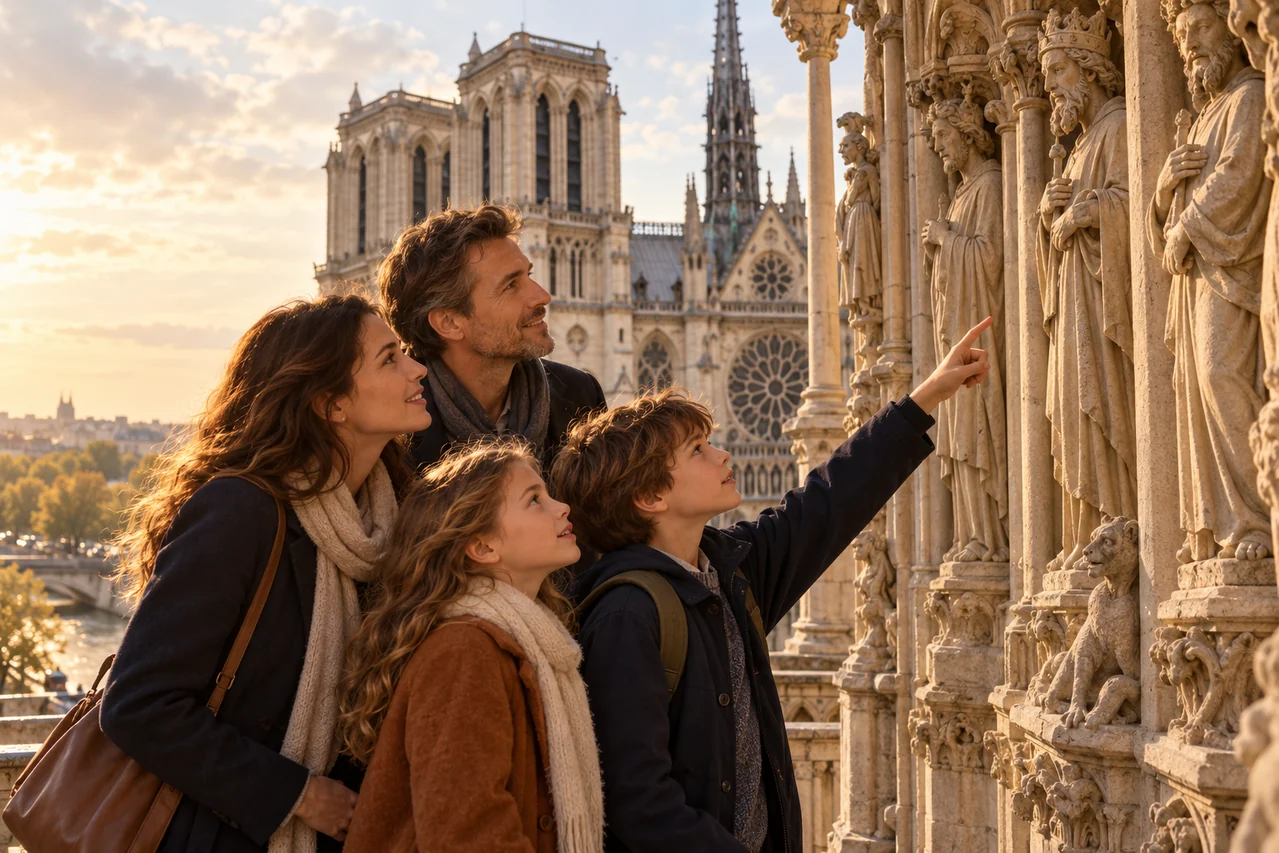
The facade, towers and sculptural details offer opportunities to look closely rather than listen continuously. A family can compare shapes, notice a repeated feature or ask why a detail seems strange. Explanation should follow the observation so curiosity has something to attach to. Not every familiar creature associated with Notre-Dame belongs to its original medieval construction; nineteenth-century restoration also shaped its imagery. That distinction can be introduced gently through the idea that monuments change over time. A playful search then becomes a beginning in heritage literacy, rather than a game unrelated to the place the family has come to discover.
Invite them to imagine a different neighborhood
The space around the cathedral once had a denser urban form. Asking how people would move through narrower streets or see a large building amid nearby houses makes that change tangible. Questions about sound, crowding and perspective can engage several ages without requiring each participant to remember the same dates. Specific details should still remain grounded, and imagined possibilities should be presented as imagination. Looking for medieval Paris around Notre-Dame explains the boundary between surviving traces and reconstruction. For families, that boundary can be part of the fun: what can we see, what has changed, and what must we picture for ourselves?
Let a character connect the different subjects
Esmeralda can provide continuity across literature, the monument and the imagined city. Rather than receiving separate explanations of architecture, Hugo and medieval Paris, participants encounter questions that arise from one fictional perspective. This narrative thread can help children follow a visit whose themes might otherwise feel disconnected. It does not require presenting the character as a real historical person or claiming that the neighborhood remains the original set. The cultural value lies in moving between story and place with clarity. Adults can find literary depth while younger participants follow a recognizable person, allowing different generations to share the experience without identical knowledge.
Adjust dark themes with care
Hugo's novel contains obsession, coercion, violence and death. The youngest participants do not need every detail, but an age-appropriate approach should not falsely describe the original as an uncomplicated romance. With teenagers, themes of reputation, power and judgment can support thoughtful conversation. The depth, vocabulary and emphasis should fit the group, including its sensitivities. Frollo's behavior should not be romanticized as simply love. The relationships among Hugo's characters offers context for that care. An advisor can communicate the family's ages and interests so the literary encounter has suitable points of access without promising a particular adaptation not agreed with the team.
Choose one complementary place rather than every nearby monument
Sainte-Chapelle can introduce a different aspect of medieval architecture and royal history; the Conciergerie can open other periods and stories, including Marie-Antoinette. They should not be described as interchangeable locations in Esmeralda's plot. Thematic proximity is enough to connect them when their individual histories are kept clear. For a family, the choice should depend on attention, interest and the actual practical arrangements for the day. One well-selected complement may work better than a sequence of interiors. Any admission requirements and availability need separate confirmation; a narrative connection does not by itself create an access arrangement.
Consider tone before choosing Esmeralda or Poe
Esmeralda offers an entrance through Hugo, characters and Notre-Dame. Poe gives a different route through darker stories and legends, which may interest some teenagers but need not suit every family. Nationality alone does not decide between them, and neither should be assumed appropriate merely because children recognize a name. Choosing Esmeralda or Poe develops the difference in promise. Poe's Parisian role is a literary narrative device; he did not live in Paris. The advisor's most useful question concerns the group's interests and tolerance for darker material, followed by an itinerary that leaves space between substantial experiences.
Preserve energy for a shared memory
A strong encounter, one monument and a few thoughtful observations can produce a more coherent day than a crowded schedule. Breaks, food and movement belong to the design of a multigenerational itinerary. The goal is not to make children reproduce every date, but to help them tell something meaningful afterward: why a character mattered, how a neighborhood changed, or what made them look differently at the cathedral. Adults benefit from the same clarity. Notre-Dame becomes a shared cultural memory when each family member has a way to participate, and when the day gives them enough attention and time to notice one another's discoveries.
FOR YOUR GUEST ITINERARIES
Designing Paris for a family or multigenerational group? Share the participants' ages and interests with Elyrea so the Esmeralda encounter can be positioned within a balanced Notre-Dame itinerary.
Discuss your itinerary