
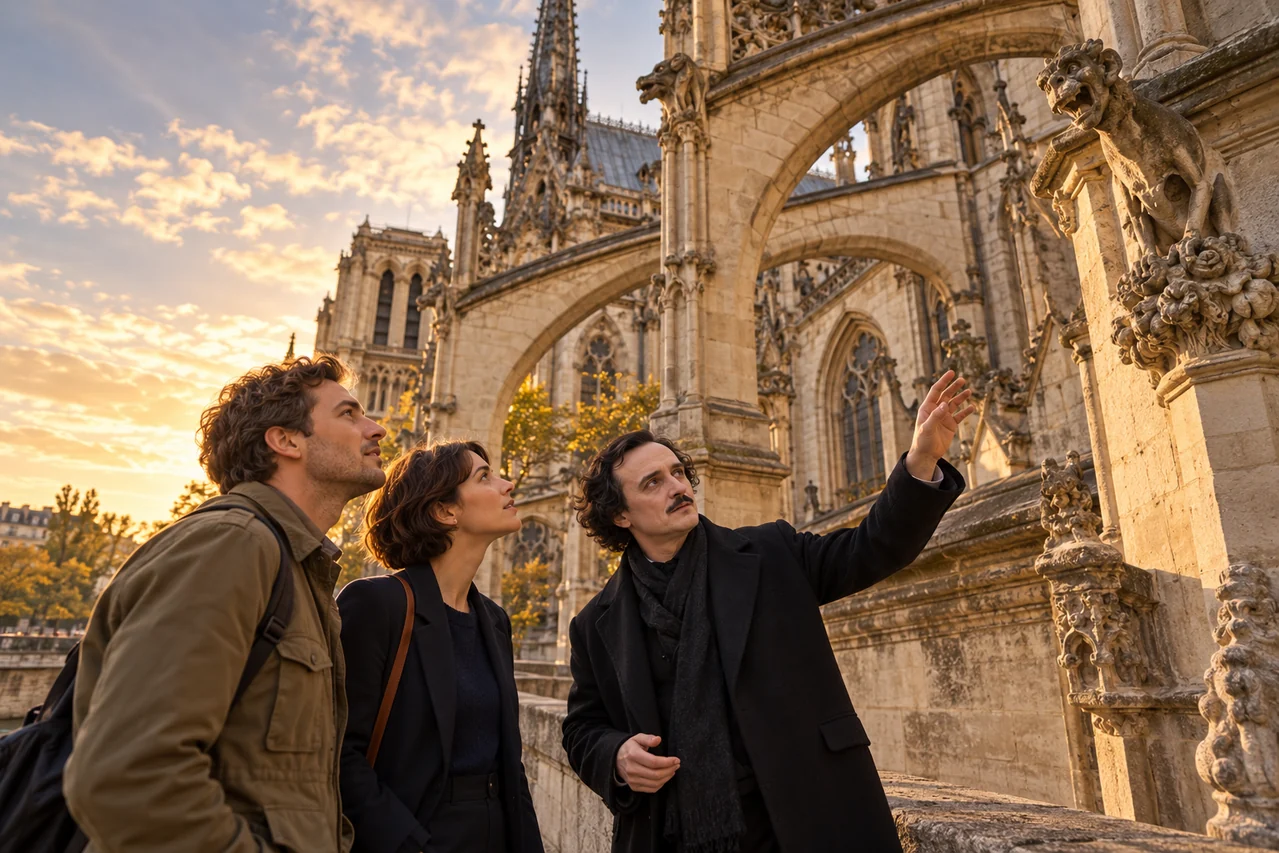
Identify what the visitor has actually seen
A previous Notre-Dame visit may have meant a photograph outside, an architectural tour or a long exploration of the interior. Those experiences do not leave the same understanding. Advisors can begin by asking what the guest remembers and what still interests them. This avoids both unnecessary repetition and the assumption that the whole district has been exhausted. A familiar landmark can remain valuable when the surrounding history or literary perspective is genuinely different.
Read the cathedral as a changing building
Notre-Dame is not a monument frozen at one moment. Construction, restoration, the fire and reopening all belong to its long history, although a new itinerary need not recount every phase. Returning guests can consider how their own image of the building relates to that changing life. The subject should be approached through verified interpretation rather than predictions about access or visitor conditions. Practical arrangements require separate confirmation and should not be inferred from the literary Encounter.
Move from the façade to the vanished neighborhood
The current openness of parts of the island contrasts with earlier dense urban fabric. Explaining that transformation gives a repeater something new to picture without adding another monument. Smaller streets around the cathedral can provide a change of scale, but the route should distinguish what survives from what is reconstructed in the narrative. The darker stories of the Île de la Cité develops this approach through the relationship between visible place and historical imagination.
Choose institutional history when that is the interest
Sainte-Chapelle and the Conciergerie offer different cultural subjects in the wider area. They should not be inserted automatically because they are nearby. One guest may want architecture and religious patronage; another may be drawn to political or judicial history. Selecting the relevant thread makes the itinerary more coherent. Any separately arranged interior visit has its own access conditions, and the advisor should avoid presenting a narrative walk as a promise of admission to surrounding institutions.
Use the river to change the perspective
The Pont Neuf and the Vert-Galant shift attention from the cathedral's façade to the island's relationship with water and the wider city. A returning traveler may appreciate this change of viewpoint as much as an additional fact. The route can connect different urban scales while allowing observation and conversation. It need not attach a dark legend to every stop. Some places work better as a pause or a geographical link than as another dramatic narrative episode.
Select a literary lens with a clear purpose
Poe approaches the city through mystery, legends and the question of what can be known. Esmeralda invites a relationship with the fictional Paris of Victor Hugo. Both can give a familiar district new meaning, but they do different work. Comparing the two Encounters helps clarify that choice. The selection should follow the guest's curiosity rather than assume that any literary character produces the same experience around Notre-Dame.
A bookshop can become a transition, not an invented link
A literary continuation may lead toward a bookshop or another author, but its historical framing still matters. The current Shakespeare and Company should not be confused with Sylvia Beach's earlier establishment on rue de l'Odéon. Nor should a visit imply that Poe frequented a Paris address. These distinctions allow a wider literary day to remain credible. Connections between writers can be made through reading and cultural exchange without manufacturing a shared biography.
Protect the depth that makes a return worthwhile
Repeat visitors often prefer a selected theme to a comprehensive list of nearby attractions. The advisor can decide what the day is really about and leave out elements that distract from it. An Encounter, a focused complementary visit and time by the river may give the guest more than a dense sequence of monuments. The island becomes worth revisiting because the traveler has gained a new way to understand it, not because every available site has been added to the program.
FOR YOUR GUEST ITINERARIES
Planning a return to Notre-Dame for your guests? Elyrea can help you match a Poe or Esmeralda Encounter to their interests and wider Paris itinerary.
Discuss your itinerary