
A famous bookshop built on the practical work of reading
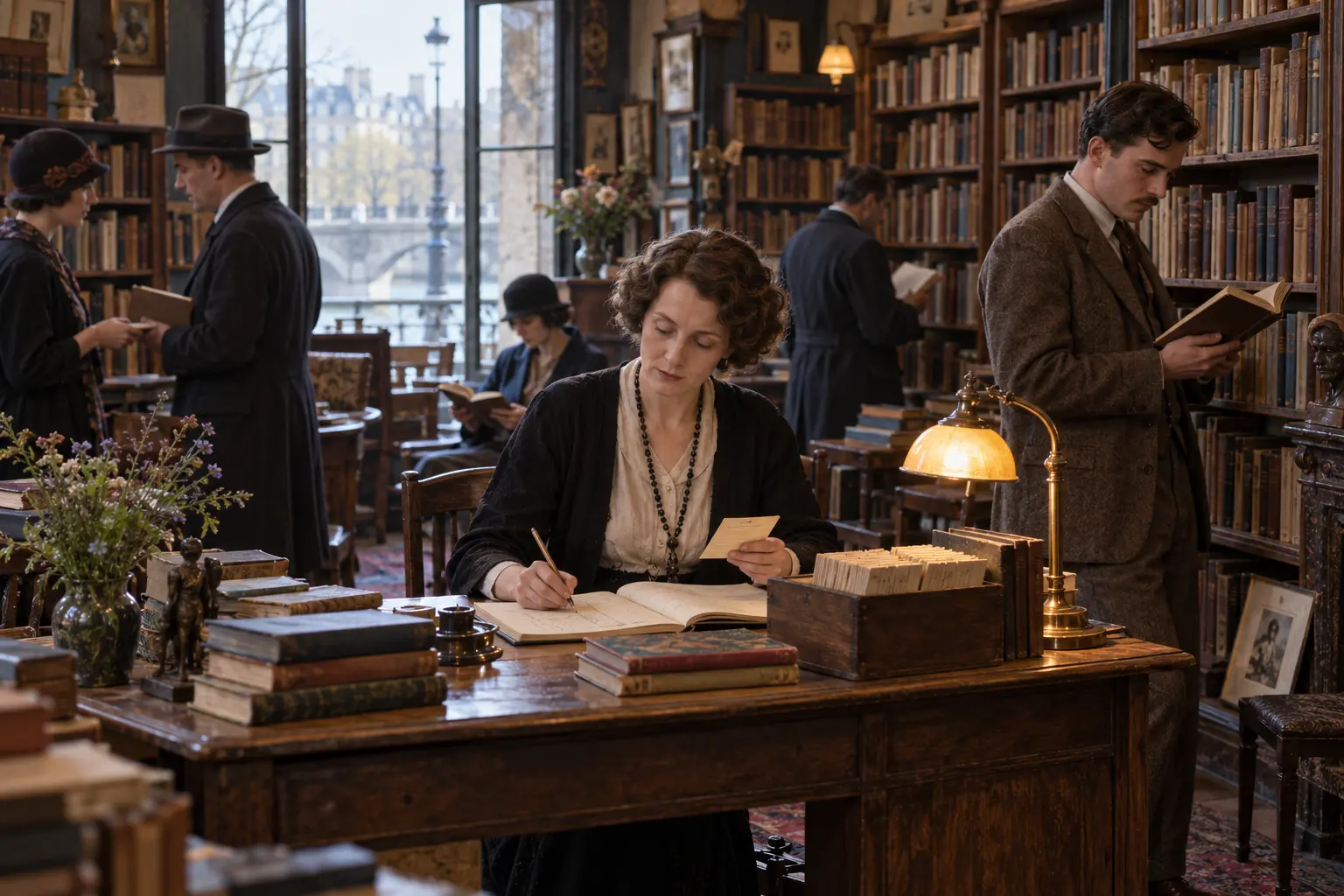
Shakespeare and Company quickly summons Ernest Hemingway, James Joyce and Gertrude Stein. That constellation of famous names can obscure the system that made a literary community possible. In 1919, Sylvia Beach opened an English-language bookshop that also operated as a subscription lending library. Books were not simply purchased and carried away. They moved from shelf to reader and back again, generating advice, conversation and new relationships. Princeton’s archive-based project now reconstructs part of that movement through membership cards, logbooks and address books. These records change the question a literary traveler can ask. Instead of merely wondering who crossed the threshold, we can investigate what members borrowed, when they borrowed it and how a Paris address supported sustained reading in English. The result is a more material history of the Lost Generation, grounded in access, record keeping and Beach’s daily labor.
From rue Dupuytren to the rue de l’Odéon
Beach opened the first Shakespeare and Company at 8 rue Dupuytren in 1919. In 1921, she moved to 12 rue de l’Odéon, opposite Adrienne Monnier’s French bookshop and lending library, La Maison des Amis des Livres. That relationship matters as much as the later prestige of the address. Monnier, Beach’s partner, had developed her own institution, and the two shops created a powerful exchange between languages, authors and readers. A careful itinerary must also distinguish Beach’s enterprise from today’s Shakespeare and Company near Notre-Dame. The latter was founded later under another name before adopting Beach’s celebrated one. Beach closed her shop during the German occupation in 1941 and never reopened it. Accuracy here protects the story from an easy but false continuity. The historical institution, its successive addresses and its modern legacy are connected, but they are not the same place.
How a subscription lending library worked
Imported English-language books could be expensive, so membership offered access to a collection larger than most readers could own. Subscribers registered, paid according to available plans and borrowed titles recorded by Beach and her staff. The surviving cards and logs preserve names, addresses, dates and transactions, though they contain the ordinary gaps of documents created to run a business rather than satisfy future historians. Princeton identifies nearly six hundred subscribers in the circulation cards, a reminder that the institution extended far beyond a handful of celebrated writers. Students, artists, professionals and less familiar readers shared the system. The library made English-language literature available in Paris, while Beach’s recommendations guided discovery. Each loan linked a catalog, a reader and the city in which that reader lived. Circulation was therefore both literal—the movement of a book—and social, as reading choices traveled through conversation and example.
What Hemingway’s records reveal—and what they cannot
Hemingway’s membership cards and borrowing activity survive for parts of the 1920s and 1930s. They demonstrate his practical use of the library and allow researchers to study certain reading choices. They do not provide a complete map of every influence. A borrowed book may not have been finished, while a title absent from the ledger could have been bought, received as a gift or consulted elsewhere. The records matter because of their material precision. They replace the romantic silhouette of a writer in a café with dates, titles and ordinary acts of reading. Paris for American travelers seeking the Lost Generation places those acts within a broader city. Beach then emerges not as a supporting character in Hemingway’s legend but as one of the people who built the conditions in which his reading life could develop.
Sylvia Beach as publisher and literary mediator
Beach’s role reached far beyond lending. In 1922, she published James Joyce’s Ulysses under the Shakespeare and Company imprint when the novel faced legal and commercial barriers in the English-speaking world. The undertaking demanded money, coordination with printers and subscribers, and a difficult long-term relationship with its author. It demonstrates how a small bookshop could become an actor in international literary history. Yet reducing Beach to the publisher of Joyce would create another narrow story. Her regular work involved recommending, ordering, lending, welcoming and introducing. That sustained mediation helped readers encounter experimental writing and allowed authors to observe how books traveled through a community. Ulysses marks an extraordinary summit, while the lending records reveal the infrastructure operating day after day beneath it. Both scales are necessary to understand her achievement.
A community larger than its canonical men
Research based on Beach’s papers continues to widen the portrait of the library. Alongside canonical writers appear women, French readers, Black intellectuals, students and people whose lives generated fewer published memoirs. Their presence changes the meaning of a literary network. A community includes not only authors who become famous but also readers, translators, assistants and organizers who make exchange possible. The data remain incomplete; digitization cannot turn every silence into certainty. It can, however, support better questions. Who could afford membership? Where did readers live? Which books circulated widely despite being less prominent today? For travelers, this approach produces a literary Paris that is less monumental and more human. It replaces a parade of plaques with shared practices and restores the many forms of work surrounding the creation and reception of literature.
Turning the Left Bank into an itinerary rather than a shrine
A strong literary itinerary should not rush from one commemorative marker to another. It can begin on the rue de l’Odéon by explaining the proximity of Beach and Monnier, then connect bookshops, publishing sites, homes and cafés through a defined question. The goal is not to claim that every facade preserves the atmosphere of the 1920s intact. It is to read distance and use: how long did it take to deliver a manuscript, borrow a book or join a conversation? Hemingway or Poe: two ways to read literary Paris helps identify the desired mood, while Paris for lovers of American literature broadens the day. Current access and the privacy of buildings must always be respected.
An encounter that reveals the conditions behind the work
The Elyrea Encounter in Hemingway’s Paris can return the writer to this web of reading, friendship and mediation. It need not pretend to reconstruct every loan or treat the historic shop as an available stage set. Its value is to show that authors also develop through accessible books, timely advice and people who keep a cultural place functioning. For travel advisors, the angle suits devoted readers, academics, writers and American clients who want to move beyond café mythology. A useful brief should identify favorite authors, the group’s familiarity with Hemingway and the other literary stops already planned. Elyrea can then help create a sequence in which Sylvia Beach occupies her proper place—not merely as a hostess to famous men, but as an architect of literary circulation in interwar Paris.
FOR YOUR GUEST ITINERARIES
Planning a literary Paris itinerary? Elyrea can help connect authors, reading lives and Left Bank places for your clients.
Discuss your itinerary