
The story is more precise than a simple act of smuggling
The Russian episode of 1814 is often compressed into a thrilling sentence: Madame Clicquot defied the blockade and sent her champagne through before anyone else. That version captures boldness but blurs the chronology. The House’s official account states that she shipped 10,550 bottles of the 1811 vintage toward Saint Petersburg so that she would be first on the scene when the blockade on French goods was lifted. The distinction matters. It does not remove danger or uncertainty; it places the intelligence of the operation in anticipation. Barbe-Nicole Clicquot did more than force a closed border. She prepared wine, financing, containers, transport and commercial relationships in order to use a political opening whose timing remained fragile. Patience in preparation and speed in execution belong to the same decision. For culturally curious travelers, this careful sequence is more revealing than the legend because it shows what strategic courage looked like before instant information.
Russia was a market before it became the great 1814 opportunity
Russian interest did not suddenly appear after Napoleon’s fall. European courts already valued Champagne, and the Clicquot business had worked across borders before the crisis. War, import restrictions and unstable routes nevertheless made the movement of French bottles difficult. Sparkling wine also imposed a particular constraint: it could not be treated like still wine carried in cask without losing the quality that defined it. Reaching customers required knowledge of tastes, agents and transport as well as a cellar ready to supply them. Reading Madame Clicquot’s wider biography helps place the shipment within a sustained commercial career. The year 1814 was not an isolated miracle. It was the point at which relationships and preparation accumulated over time became visible. First-mover advantage only has value when there is already a destination, a demand and someone capable of receiving the goods.
The 1811 vintage raised both the promise and the risk
The wine belonged to the 1811 harvest, remembered in Champagne through the great comet visible that year. Veuve Clicquot describes the Comet Vintage as an exceptional wine. The comet should not be turned into a scientific explanation for quality; it functions primarily as a cultural marker in the vintage’s afterlife. For Madame Clicquot, having a remarkable wine strengthened the opportunity while increasing what was at stake. Thousands of bottles represented capital, labor, reputation and fragile goods placed into an uncertain journey. A bold business decision is therefore more than an expression of personality. It requires choosing what one is willing to risk and believing that the product can convince people once it arrives. The vintage gives logistics a sensory consequence. Russian buyers would taste, compare and recommend the wine. The commercial plan could create an encounter, but only the wine itself could turn that arrival into a lasting preference.
Preparing for the blockade to lift
Europe’s political order shifted quickly in 1814 as the campaign in France, Napoleon’s abdication and the Bourbon Restoration altered relations among states. A merchant did not experience those events as a perfectly legible transition. News traveled slowly, ports and customs could apply changing decisions, and competitors were watching for the same relaxation of restrictions. The advantage came from work completed before reopening was certain. This is why “despite the blockade” is best understood as the environment of constraint rather than proof that a clearly documented shipment simply crossed an unchanged prohibition. The House says the objective was to arrive first when French goods were admitted again. That more exact formulation reveals an entrepreneur reading politics as commercial information. She accepted that knowledge would remain incomplete but reduced the delay between authorization and arrival. In modern language, the strategy combined scenario planning, inventory commitment and speed, yet its execution still depended on people, ships and administrative decisions beyond her control.
What 10,550 bottles tell us about organization
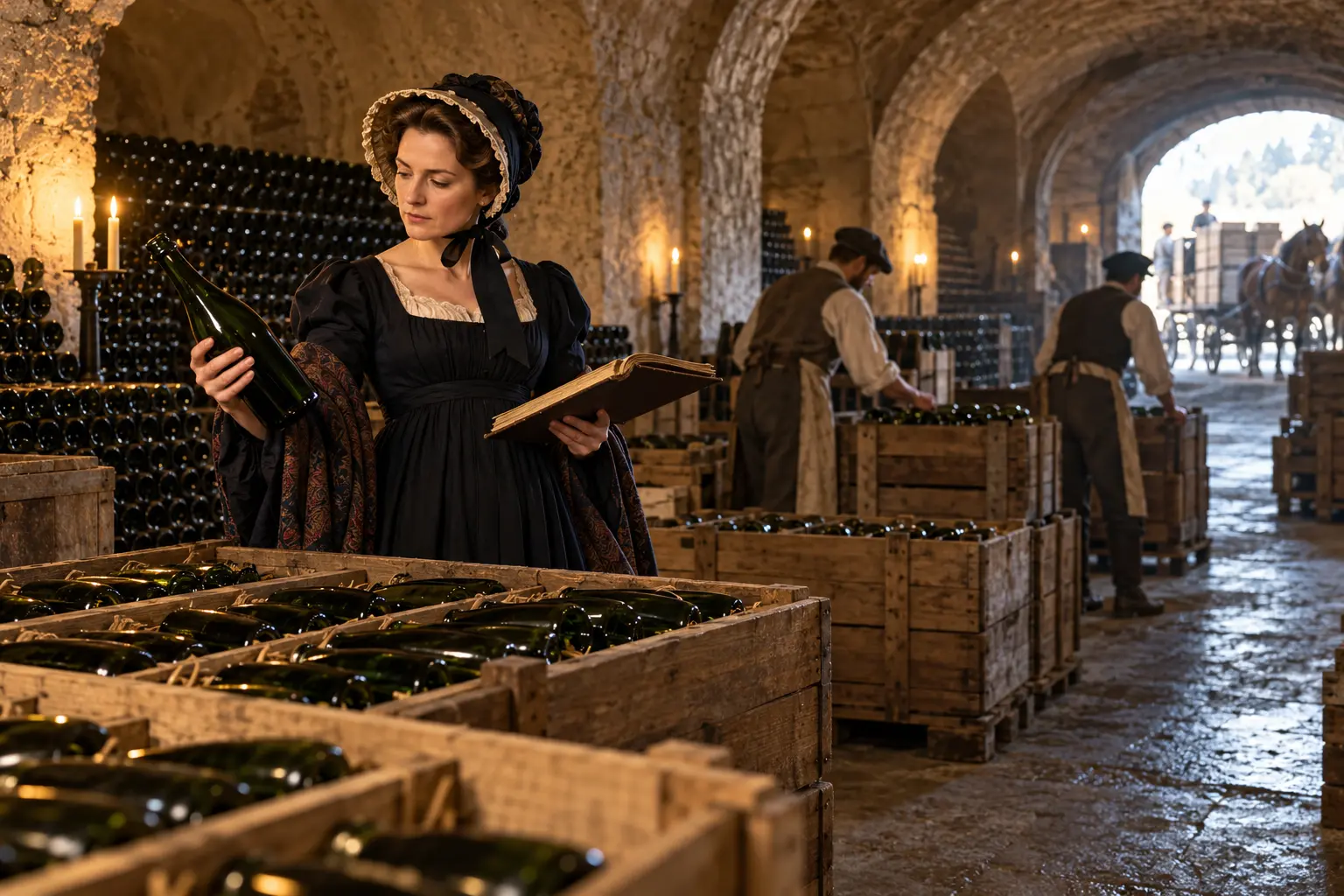
The official number matters less as a dramatic total than as evidence of organization. Wine had to be selected, pressure-resistant bottles assembled, goods protected in crates, departure coordinated and reception prepared. Madame Clicquot’s decision therefore depended on cellar workers, suppliers, carriers and commercial representatives. Restoring that collective does not diminish her leadership; it makes her ability to mobilize an enterprise measurable. The story of a 27-year-old widow taking charge of a champagne business becomes material here. Authority means turning insight into instructions, accepting costs before a sale and protecting quality along the route. A shipment arriving late or damaged would not have produced the same reputation, however elegant the plan sounded. The crates in a cellar are therefore not merely picturesque scenery. They represent the point where judgment becomes operations and where every apparently glamorous bottle acquires a history of manual work and coordination.
Arrival was only the beginning of adoption
Reaching Russia was not the same as establishing a durable market. Champagne had to encounter demand, circulate through social networks and become associated with celebration among consumers. Veuve Clicquot’s account describes a triumphant reception, an outcome that converted timing into international reputation. Military language such as “conquering Russia,” however, can hide the decisions of Russian buyers and intermediaries. Markets are not won like battles. They develop through repeated choices, recommendation, availability and recognizable quality. The language of conquest belongs to the commercial legend; the more interesting history concerns the relationship between a product from Champagne and people ready to value it. This nuance also helps travel advisors present the episode without turning European conflict into a decorative backdrop. The end of restrictions opened a route, Madame Clicquot used it with unusual speed, and the reception gave the shipment meaning. All three elements are necessary to explain the success.
Commercial innovation and cellar innovation are different achievements
Madame Clicquot is also associated with technical changes, most famously the riddling table developed a little later to help produce clear wine. The 1814 shipment belongs to another field: market knowledge, risk, logistics and timing. Connecting the two is useful when it reveals a consistent demand for control, but misleading when every achievement is folded into one invention myth. Our article on riddling and the transformation of champagne explores that separate process. Together, the stories reveal a complete company. Cellar work addressed quality and consistency; commerce built circulation; the brand later gathered both into cultural memory. This approach moves beyond a solitary-genius portrait. It shows a leader making decisions at very different scales, from the treatment of individual bottles to the movement of thousands across Europe. Guests interested in business can therefore discuss innovation without reducing it to a single dramatic breakthrough.
Placing the 1814 decision in a cultural itinerary
For a travel advisor, the episode can connect Reims, Paris and wider European history without implying access to cellars, archives or services that are not part of the booking. A tasting gains depth when guests understand that wine was also an object of diplomacy, transport and reputation. Elyrea’s encounter with Veuve Clicquot can provide an embodied perspective on that ambition, while tasting arrangements and institutional visits must be confirmed separately. The angle works for wine enthusiasts, entrepreneurs, travelers interested in women’s history and guests who enjoy following the movement of ideas and taste. A brief should note their knowledge of Champagne, preferred language and the sequence planned around the encounter. The 10,550 bottles then cease to be a polished anecdote. They become a concrete measure of preparation under uncertainty and an invitation to ask how products, people and political moments combine to create an international reputation.
FOR YOUR GUEST ITINERARIES
Planning Champagne for guests interested in great entrepreneurs or European exchange? Elyrea can help you place this story within their journey.
Discuss your itinerary