
A commission after military success
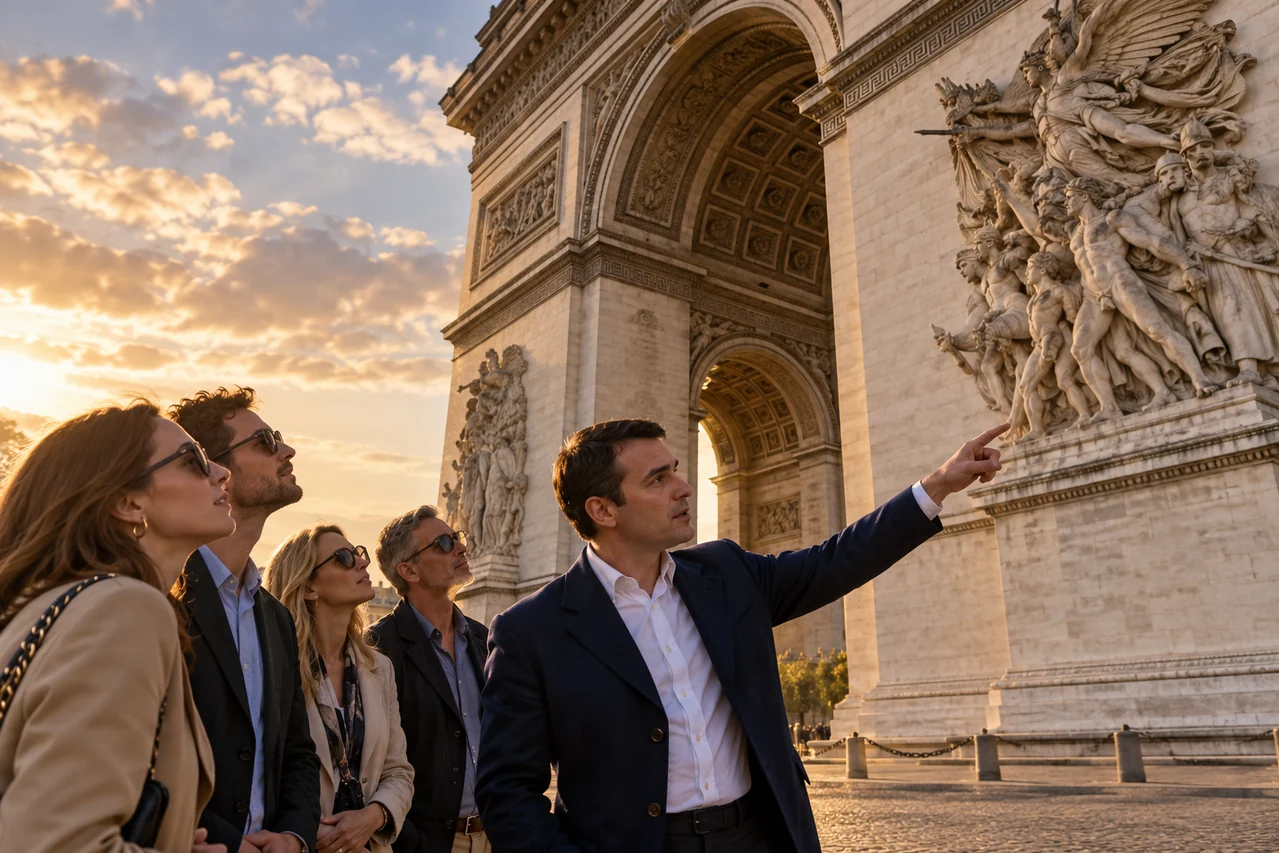
Napoleon commissioned the Arc de Triomphe in 1806, linking the project to the celebration of his army and its victories. The monumental form made military achievement part of the capital's public landscape. A visitor can therefore begin by asking what the regime wanted to communicate, not merely when construction started. Victory was to be represented in a durable urban setting. The monument belonged to a political use of architecture through which a ruler sought to shape how power would be seen and remembered.
The emperor did not see the finished building
The Arc was completed in 1836, after Napoleon's death and under a different political regime. That chronology is essential because the finished monument is often imagined as a place he personally knew. It instead demonstrates how projects can outlive their initiators. Construction, interruption and later completion changed the relationship between the building and its original purpose. Travelers encounter an imperial commission whose realized form also belongs to subsequent decisions about what France should preserve and commemorate from its recent past.
A temporary version served imperial theater
For Napoleon's marriage to Marie-Louise in 1810, a temporary representation of the planned Arc supplied an image of the future monument. This episode reveals the value placed on ceremonial appearance before the permanent structure existed. It should not be confused with the completed building. The distinction is useful for travelers interested in political staging: an architectural image could already perform a public role, while the actual construction followed a longer and less straightforward timetable than a triumphant procession suggested.
The stone records a military past
Names of battles and military figures, together with sculptural ensembles, connect the Arc to the Revolutionary and imperial wars. Reading those features turns the structure into more than a viewpoint above the city. Yet inscriptions are selections made within a commemorative project, not a complete history of the period. A thoughtful visit can ask what is honored and how that honor is represented. Napoleon's military reputation provides context while retaining the human cost behind the language of celebrated victories.
Napoleon returned through memory
In 1840, Napoleon's remains were brought back from Saint Helena, and the funeral procession passed beneath the completed Arc before reaching the Invalides. A monument he had not seen finished became part of his spectacular return to France's national memory. The sequence connects a person's death with later political and cultural decisions. It is especially revealing for travelers who assume commemoration simply preserves an unchanged past: the meaning of Napoleon continued to be produced after his own rule had ended.
The Unknown Soldier added another layer
The Tomb of the Unknown Soldier after the First World War and the flame of remembrance made the Arc a central place of national commemoration beyond the Napoleonic period. That later role must receive respect in any itinerary or performance nearby. The site is not solely a stage for imperial ambition. Its present meaning includes remembrance of sacrifice and loss, requiring visitors to move between different historical layers rather than interpret every feature as though it came directly from Napoleon.
Compare the Arc with the Invalides
The Invalides offers another relationship with Napoleon, especially through his tomb and the military collections. Tracing his Paris legacy can connect the two settings without treating them as duplicates. One place opens onto monumental public memory; the other brings the individual's afterlife and military context into focus. Advisors can choose how much of that comparison a guest needs. A focused relationship between sites is often more useful than an exhaustive tour of every imperial reference in the capital.
Let strategy become a question about memory
A Napoleon Encounter can use the Arc to consider not only how battles were won, but how victories were converted into symbols. This shifts the discussion from action to its representation. The theatrical character's viewpoint remains an interpretation, while the monument supplies evidence of later layers he could not control. For travel advisors, that makes the area useful for repeat visitors, military enthusiasts and guests interested in political history, with practical access and the respectful treatment of commemorative spaces considered separately.
FOR YOUR GUEST ITINERARIES
Planning an Arc de Triomphe visit with cultural depth for your guests? Ask Elyrea how a Napoleon Encounter can connect imperial strategy with the monument's later layers of memory.
Discuss your itinerary