
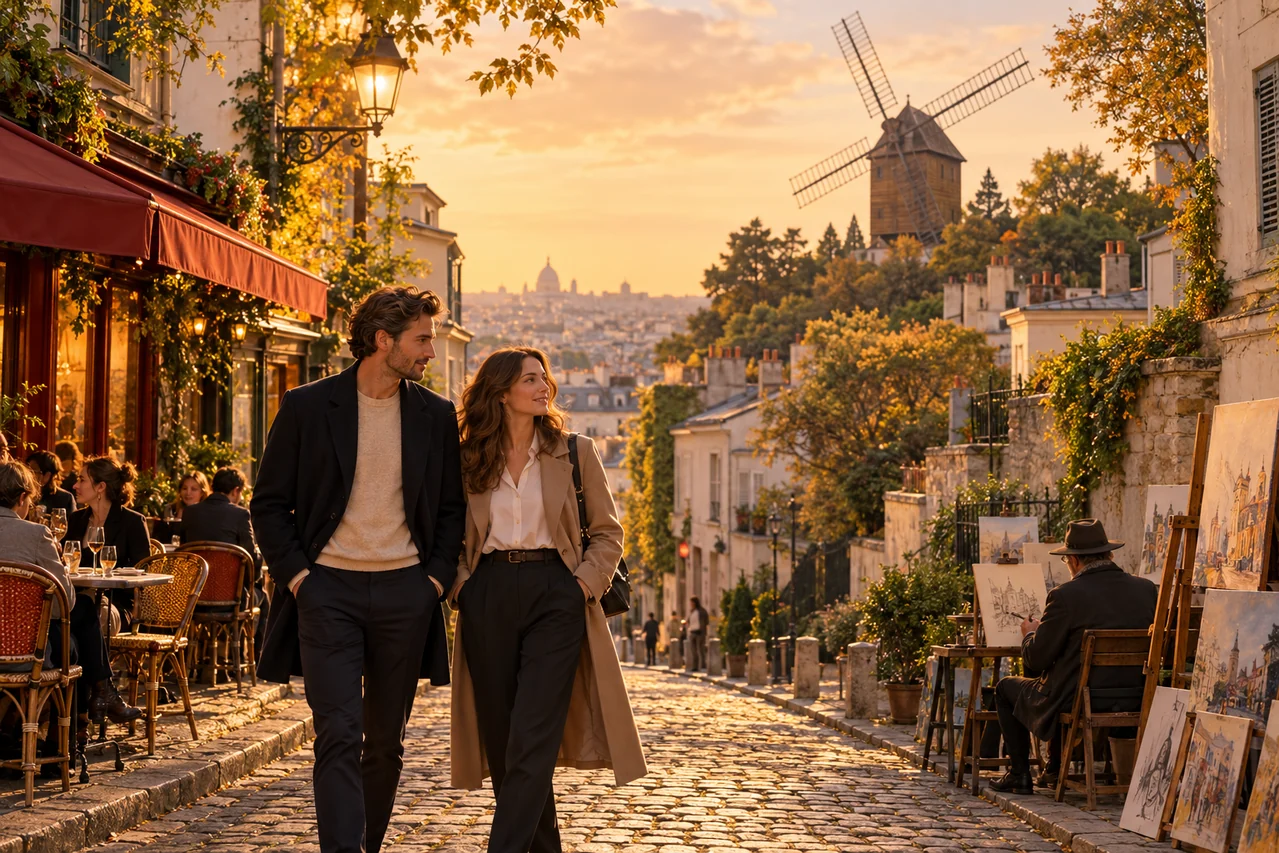
The Moulin was a place of living first
The Moulin de la Galette became culturally memorable through art, but people initially gathered there to dance and socialize. Its importance begins with that ordinary function. Modern painters found subjects in contemporary life rather than needing every scene to depict history or mythology. The setting therefore invites visitors to consider why leisure could become an important artistic question. Understanding the place as a social environment makes its connection with painting more meaningful than simply recognizing a famous name from a label.
Renoir transformed sociability into painting
Bal du moulin de la Galette connects the setting with Renoir's attention to people, shifting light and collective movement. The work does more than record an address: it organizes a crowded contemporary scene into a pictorial experience. Seeing the place can help visitors connect life and representation while recognizing that a painting is a constructed work, not a transparent photograph of the past. The different concerns of Impressionist artists place Renoir's interest in people alongside other approaches within the movement.
The Bateau-Lavoir moves the chronology forward
The Bateau-Lavoir is especially associated with Picasso and the early twentieth-century avant-garde. That belongs to a later generation than the central Impressionist story. The distinction is a strength of the walk because it shows Montmartre's continuing ability to attract artists. Picasso must not be called an Impressionist. A compact neighborhood can hold several developments in modern art, but visitors need clear transitions to understand how influence and change operate rather than imagine a timeless gathering of every painter at once.
The studio brings practical conditions into view
The Bateau-Lavoir's name evokes a comparison with the washing boats once found on the Seine and recalls the rudimentary character of an artistic working environment. The later fame of its associations can obscure those conditions. A studio had to allow work before it became a heritage address. Scarcity should not be made picturesque or praised as a source of genius. It belongs to the material context that helps explain how art was produced, alongside supplies, relationships and opportunities to show it.
The Lapin Agile broadens the disciplines
The Lapin Agile introduces sociability involving song, poetry, literature and painting. Montmartre's creative life did not divide neatly into separate professional worlds. Informal gatherings allowed artists to listen, discuss and encounter other forms of expression. That matters more than an unsupported tale that a particular conversation directly caused a famous work. The place reveals an environment where different kinds of creation could share company. Cultural exchange happens through ordinary contact as well as through institutions and published manifestos.
Put the supplier back into the network
Père Tanguy represents another practical link: the provision of colors and the circulation of works. His role among modern painters complements the studio, social venue and scene of leisure. Together these functions show why an artistic district is more than a collection of addresses. People needed materials, places, company and audiences. Tanguy's historical viewpoint belongs to his own period; later settings should be explained as later developments rather than presented as if he personally witnessed every chapter of Montmartre's cultural life.
The contemporary district is not a frozen scene
Visitors now encounter these places within a heavily recognized tourist neighborhood. Functions, buildings and surroundings have changed. That does not make artistic history inaccessible, but it requires attention to traces rather than promises of an untouched past. Why Montmartre became an artists' district explains the conditions behind its reputation. The effect of later tourism is another stage in that development, not simply an obstacle that must be ignored for the historical narrative to work.
Give each place a role in the day
A thoughtful itinerary can use a small number of places to answer complementary questions: what did artists observe, where could they work, and how did ideas circulate? That is more coherent than trying to see every possible landmark. An Encounter with Père Tanguy can provide a human frame before a museum chapter or independent time in the neighborhood. Advisors should confirm the actual route and arrangements, allowing the editorial relationships to guide the program without implying every discussed site is included in one performance.
FOR YOUR GUEST ITINERARIES
Planning an art-focused Paris stay for your guests? Elyrea can help you connect Père Tanguy's perspective with a deeper reading of Montmartre's studios, leisure spaces and cultural networks.
Discuss your itinerary