
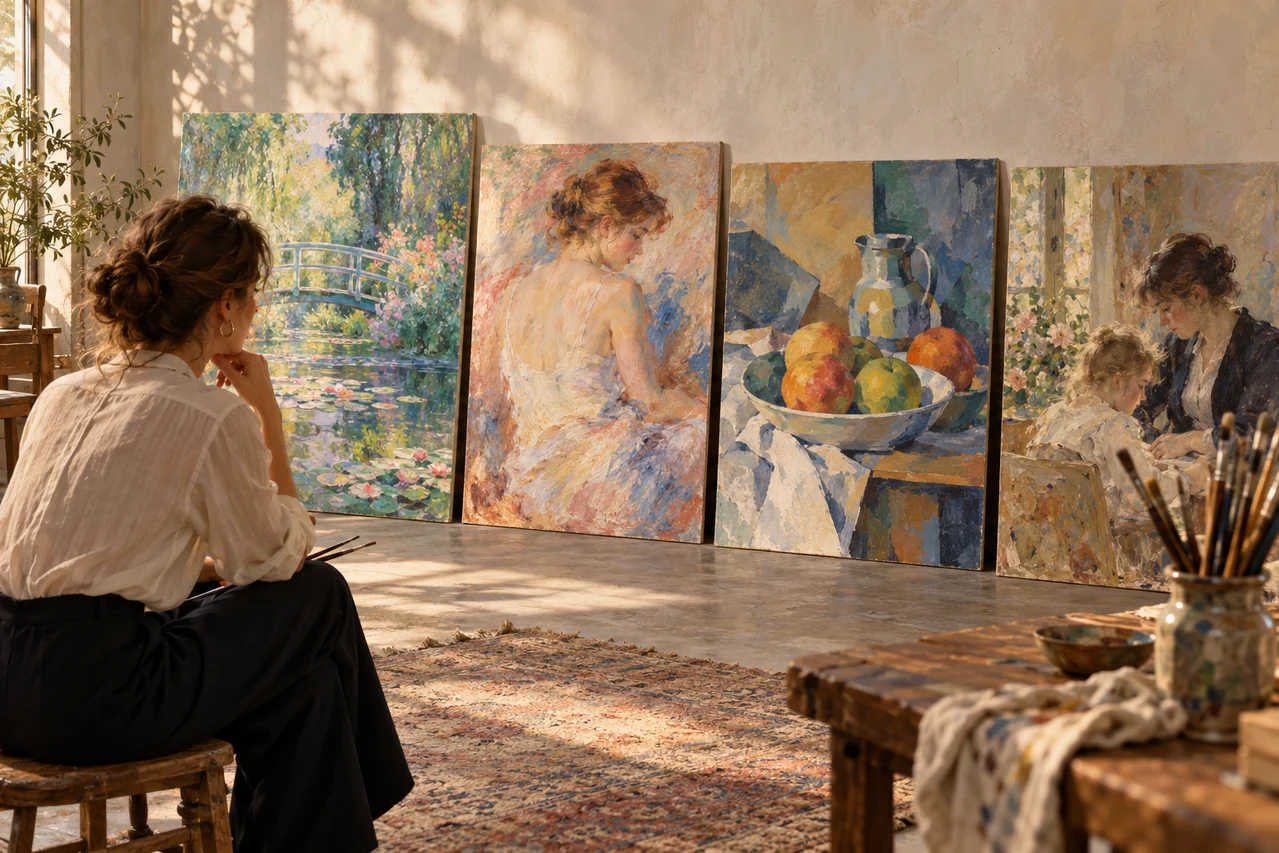
Monet studies what changes
Monet's attention to light and atmosphere makes an apparently stable subject into a changing visual problem. Time, weather and season alter what is seen, giving repeated motifs a purpose beyond repetition. His later Nymphéas are part of a long career, not the entirety of it. Monet's relationship with light helps connect early interests with later research. Recognizing that development makes Giverny more meaningful as a mature chapter rather than treating the village as the birthplace of all Impressionism.
Renoir gives sociability a central place
Renoir's association with figures and scenes of leisure offers another route into modern life. The Moulin de la Galette links people, movement and light in a setting where social interaction itself becomes a major subject. He should not be confined to that one painting or a permanently fixed style. His career changed, like those of others associated with the movement. This reminds visitors that a familiar masterpiece introduces an artist but cannot stand in for the full duration and variety of an artistic life.
Cézanne crosses the boundaries of a label
Cézanne took part in early Impressionist exhibitions, yet his investigations of structure, volume and pictorial organization moved beyond a narrow category. Their importance for later artists helps explain why classifications are useful but incomplete. His relationship with Père Tanguy also brings uncertainty into view: later influence was not yet guaranteed when works needed support and circulation. The story can connect artistic research with reception, showing how a painter's place in history developed rather than arriving fully established with each new canvas.
Morisot makes social geography visible
Berthe Morisot was a central participant in the Impressionist endeavor, not an optional addition to a history of male painters. As a woman from a bourgeois setting, her opportunities to move through public and private spaces differed from those available to men. Subjects drawn from domestic or intimate life should therefore not be mistaken for limited ambition. The social environment influenced what could be observed and under what conditions. Her work makes artistic choice and lived context impossible to separate neatly.
Cassatt provides an international connection
Mary Cassatt's career in France and participation in Impressionist exhibitions offer American travelers a particularly meaningful link. She shows that Parisian modern art was shaped through international movement, not solely by French-born painters. Her presence also broadens attention to women as artists rather than only as subjects. An itinerary can follow those connections without turning nationality into a complete explanation of style. The historical value lies in a person's work and relationships within a cultural environment larger than one country.
Pissarro and Degas complicate a simple definition
Pissarro's participation across all eight Impressionist exhibitions provides continuity within a changing group. Degas, with his interest in dance, interiors and unusual framing, shows why the movement cannot be defined only as landscapes painted outdoors. Their differences are productive rather than inconvenient. The broader changes brought by Impressionism include new subjects and exhibition structures as well as visual handling. No single checklist adequately explains every artist connected with the group, and the individual differences are essential to its history.
Influence does not equal membership
Van Gogh encountered Impressionist and Neo-Impressionist work in Paris, but his painting is generally associated with Post-Impressionism. Picasso belongs to a later generation. Their appearances in Montmartre's story should signal development rather than expand Impressionism until it means all modern painting. Artists learned from others, responded and changed direction. Preserving those distinctions gives viewers a clearer account of how ideas travel between careers, instead of placing every celebrated name into one convenient category because they worked in nearby streets.
Approach the painters before posterity
Père Tanguy gives an Encounter a perspective from material and personal relationships rather than a completed art-history survey. His place in the artists' network helps guests imagine people needing supplies, recognition and support before their works became museum certainties. Advisors can use that viewpoint alongside a carefully chosen collection visit, adjusting depth to the guest's interests. The result is not a longer list of names, but a more informed appreciation of how distinct artistic lives contributed to a history now remembered collectively.
FOR YOUR GUEST ITINERARIES
For guests with a particular artistic interest, our team can help connect the Père Tanguy Encounter with selected painters, collections and excursions rather than a generic art itinerary.
Discuss your itinerary