
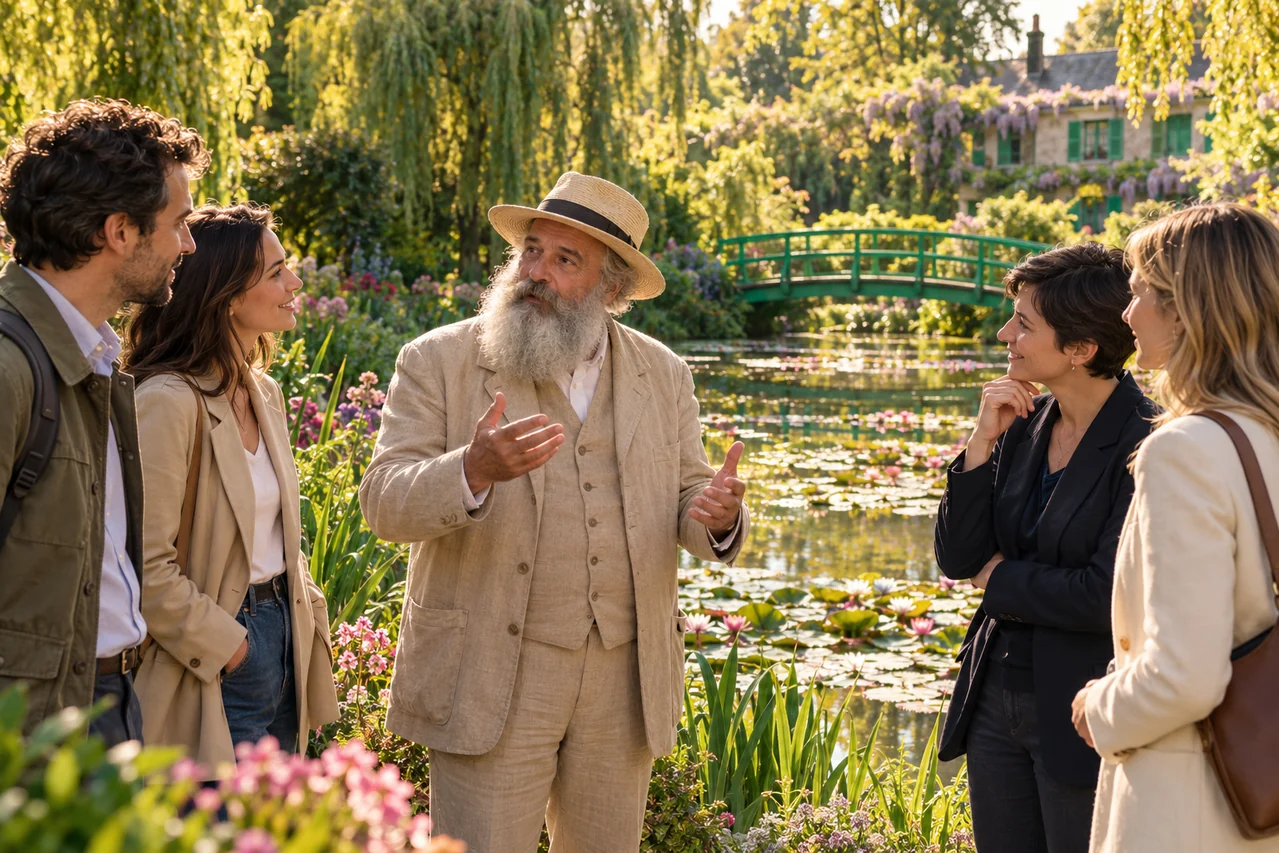
A home became an artistic environment
Monet arrived in Giverny in 1883 and remained until his death in 1926. That long relationship matters because the property did not enter his life fully formed as the familiar visitor destination of today. He first rented and later bought it, developing its gardens over time. The setting therefore reveals a process of living, working and changing a place. It was not simply a ready-made view discovered once and then copied repeatedly onto canvas.
The garden was composed as well as cultivated
Planting, colors and the organization of views gave the environment an artistic dimension before any particular painting began. Flowers remained living things shaped by weather and season, so composition did not imply absolute control. Monet worked with that tension between arrangement and change. Visitors can notice masses of color, perspectives and transitions rather than only identify celebrated motifs. The gardens as a created landscape explores the interplay between horticultural work and pictorial decisions more closely.
Water introduced another way of seeing
The water garden gave Monet a subject in which plants, reflected sky and surrounding vegetation could meet on one surface. A pond is not visually stable: light, weather and movement change its appearance. This makes it especially useful for considering perception. Guests can begin by observing what is physically present and what appears through reflection. The resulting complexity helps explain why the motif could sustain so much work without each painting being merely another version of the same view.
The Japanese connection extends beyond the bridge
The bridge is an immediately recognizable image, but Monet's interest in Japanese art also belongs to the wider story of his collection and visual world. The prints in the house help make that connection visible. A serious account should not reduce the relationship to a borrowed decorative feature or claim that Monet simply copied Japanese compositions. It can instead consider how artists and collectors encountered images from another culture and how those encounters affected looking and artistic choices.
The Water Lilies are a continuing investigation
A repeated subject can reveal different light, framing and visual relationships. Monet's pond became a way to explore those changes across many works, not a single emblematic painting. The reduced emphasis on a conventional horizon can make the image feel immersive, particularly in the large works. Why Monet returned to the Water Lilies develops that question. The gardens provide a physical starting point, while the canvases show how substantially the motif could be transformed.
The house restores a domestic scale
The interiors, colors and collection reveal a setting of family life, sociability and work. They counter the image of a solitary master standing permanently before the pond. Family members and the people who maintained the property belong within the account, even when Monet's painting remains its main focus. The house and garden therefore do different cultural work: one introduces an inhabited world, while the other allows visitors to observe the changing environment that became an artistic subject.
A familiar image can become a new observation
A guest who knows the paintings may arrive looking for the bridge photograph they recognize. An Encounter can move that attention toward a more rewarding question: what did Monet choose to include, and how did he change the view? A newcomer can begin with colors and reflections without needing a full art-historical introduction. The setting supports both levels of curiosity when the guide gives guests time to look and avoids making every stop a test of prior knowledge.
Let the Encounter turn recognition into understanding
Inside Claude Monet’s Giverny combines an embodied painter, place and conversation. The interpretation can help guests relate the physical garden to the process of painting while retaining the distinction between historical evidence and theatrical voice. Advisors can position it as a central thread within a separately planned day, with practical access verified independently. The journey's value is a deeper relationship with the work: visitors leave able to look at Monet with more than the recognition of a famous motif.
FOR YOUR GUEST ITINERARIES
For guests interested in Monet, gardens or the creative process, Elyrea can help integrate Inside Claude Monet’s Giverny into a thoughtful excursion from Paris.
Discuss your itinerary