
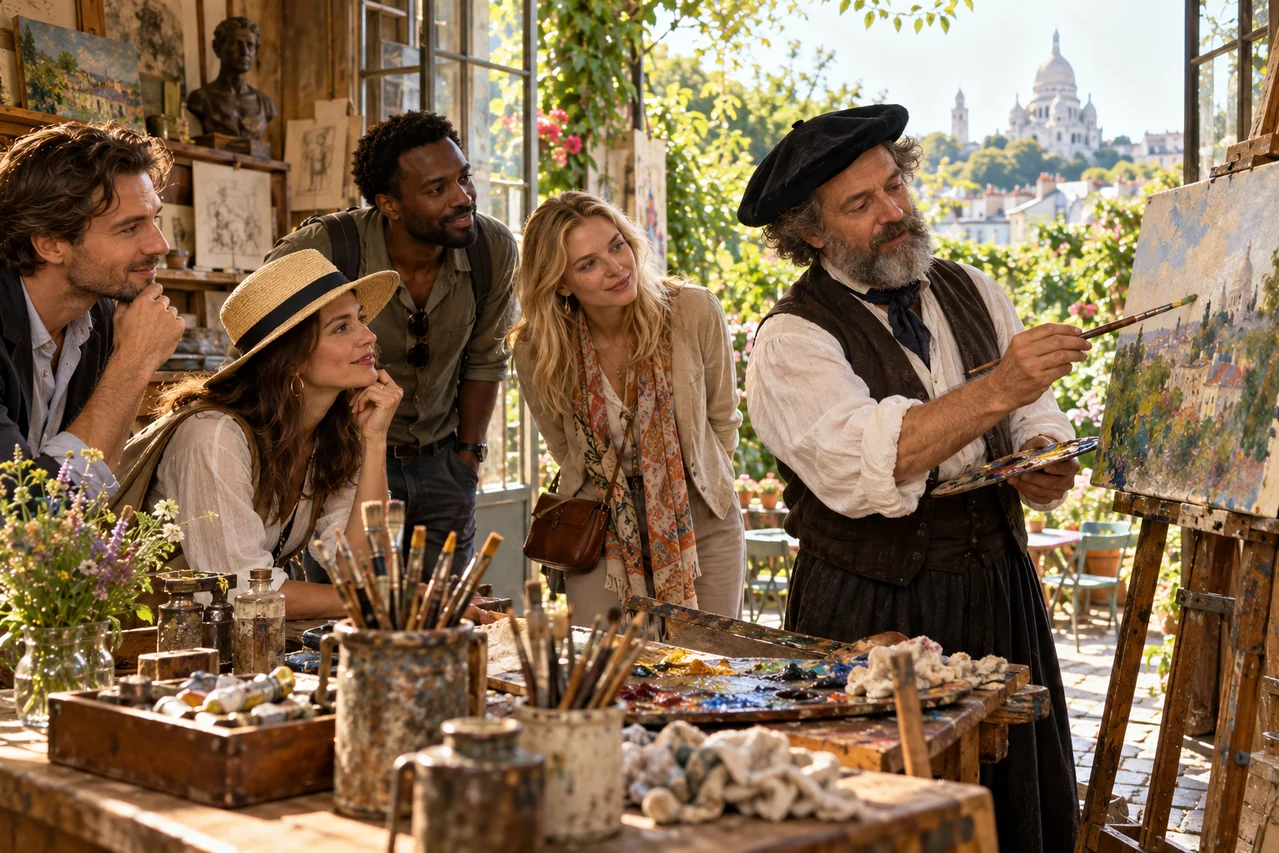
Start with the art the traveler wants to see
The first question is which works, artists or periods matter most to the guest. The Louvre, Musée d'Orsay and Musée de l'Orangerie serve different interests, and treating them as interchangeable essentials can make a day unfocused. Original works allow travelers to examine scale, surface and relationships that reproductions cannot fully convey. Choose a manageable direction before adding neighborhoods or excursions. A museum visit with a clear purpose becomes the foundation for the rest of the artistic journey. Find out whether the guest wants to revisit a personal favorite or encounter something outside an established taste. Those aims lead to different selections. A returning collector may prefer time with a small group of works, while a newcomer may need a clear comparison across a period. Share that focus when arranging the visit rather than assume that a museum's prestige establishes suitability. The chosen objects should provide questions that can travel into the rest of the itinerary. If the next chapter is a landscape, establish what the traveler has noticed about representation; if it is a neighborhood, begin asking what practical and social environment made the work possible.
Make space to look rather than count
An art itinerary is weakened when visitors rush between rooms simply to confirm that they have seen celebrated works. Give the guest time to notice light, composition or the difference between two paintings. This is especially important for travelers who enjoy discussing their response rather than receiving a comprehensive lecture. Leaving room for looking also provides questions that can be explored later outside the museum. The landscape or neighborhood then answers a curiosity that has already become personal. Allow the traveler to return to something after an initial explanation. An observation made before hearing context can change afterward, and that change is itself useful. Companions can be invited to notice different aspects without being assessed on terminology. A painter's treatment of people, a contrast of surfaces or the scale of a room provides an accessible starting point. The advisor should protect attention as a finite resource, including the moments between planned visits. A day of continuous viewing may sound ideal for an enthusiast yet leave little capacity to absorb it. Purposeful pauses make the time with actual works more rewarding, rather than reducing the amount of culture in the experience.
Read Montmartre as a working environment
Montmartre's appeal extends beyond views and its familiar artistic image. Its streets and associated places invite discussion of how artists found materials, subjects, colleagues and support. Fame can obscure the practical uncertainties that shaped their daily work. A walk through the district should therefore explain an environment rather than simply recite names. Exploring artistic Montmartre with Père Tanguy provides a route into these relationships, helping travelers imagine painters as people making choices before their work acquired international recognition. Chronology is essential because the district's international image combines several generations. Renoir's relation with contemporary leisure, Van Gogh's Parisian discoveries and Picasso's early twentieth-century work do not belong to a single group living together indefinitely. Van Gogh is generally associated with Post-Impressionism, while Picasso belongs to later developments. Make transitions explicit so that influence can be understood without becoming a false claim of membership. The present neighborhood also contains changed functions and later layers. Explaining those differences gives travelers a clearer way to read its traces, avoiding an impression that artistic history survives as an untouched scene behind today's streets and shops.
Follow the people behind the painters
Julien Tanguy's interest lies partly in his position outside the conventional gallery of great artists. A color merchant and supporter of several painters, he brings materials, exchange and personal relationships into view. This perspective changes the questions travelers ask: where did the paint come from, who helped an artist continue, and how did work reach an audience? Art history becomes less isolated from ordinary life. It also gives knowledgeable guests a different point of entry without requiring the itinerary to abandon the paintings themselves. A supplier's story can also alter how guests think about recognition. What we now call a masterpiece was once a work needing materials, display and somebody willing to consider it without a museum's guarantee. That does not mean every neglected artist was destined for later success. It shows why retrospective fame can conceal the uncertainty of making. Include the practical network without assigning the merchant equal artistic authorship or turning support into prophecy. For creative professionals, this perspective can be stimulating on its own terms; it does not need to transform nineteenth-century painters into contemporary business examples to become relevant to questions about work, exchange and reception.
Understand why Giverny belongs in the story
At Giverny, Monet's garden connects the act of making a landscape with the act of painting it. The visitor can consider how surroundings became part of an artistic project rather than simply recognize a famous image. The house and garden offer different clues, and both deserve attention when they serve the guest's interests. Entering Monet's Giverny works particularly well alongside looking at his paintings: the journey moves between representation and the environment that sustained his investigation of light and visual perception. The garden deserves attention as a made place rather than an exact three-dimensional copy of the paintings. A view selected by the traveler and the pictorial space created by Monet can differ in organization, emphasis and scale. That comparison is part of the interest. The house can bring daily life into the discussion while the garden reveals sustained observation, provided the practical arrangements for visiting are confirmed independently. Avoid trying to fit every aspect into a brief photo stop. Moving from an urban collection to Giverny should change the guest's pace as well as the scenery, giving enough time for the relationship between cultivation and painting to become an experienced question.
Approach Auvers through the work as well as the life
Auvers-sur-Oise offers connections between places and the paintings Van Gogh made during his final weeks. The village can be emotionally powerful, but it should not reduce an extraordinarily productive artist to the circumstances of his death or mental health. Allow his subjects, methods and relationships to occupy substantial space in the visit. Van Gogh should not be labeled an Impressionist simply to simplify an itinerary. The differences between his work and Monet's are part of what makes a combined artistic journey valuable. A respectful visit can give a biographical place emotional significance while keeping artistic work central. Ask what a painting does with a motif rather than only identifying where the artist stood. Explain uncertainty around sensitive events without offering dramatic speculation as a more exciting alternative. The traditional account of Van Gogh's death and debated details require different levels of confidence; his work cannot be explained solely through either account. Contemporary visitors can observe surviving places while recognizing that buildings, landscapes and uses have changed. An advisor should leave room for reflection rather than impose an expected emotional response, especially when a site includes personal loss and commemoration.
Connect destinations without pretending they tell the same story
Paris, Montmartre, Giverny and Auvers can form related chapters, but the relationship should be explained rather than assumed. A useful thread might be the search for a place to work, the importance of artistic support or changing ways of representing a landscape. Each destination then contributes a distinct answer. Building a journey around the great painters can help an advisor preserve those differences while avoiding the fatigue of too many collections, transfers and densely interpreted visits. The sequence can remain flexible without losing coherence. A guest who already knows Monet well might start with a Paris collection and move to the garden; another might use the landscape to create curiosity before looking at paintings. Separate days can be organized around practical conditions while the connecting question is retained. Explain each transition when presenting the itinerary, including why a destination has been omitted. An additional site is not automatically valuable because it relates to a famous artist. It earns its place when it introduces another way of making, looking or sustaining work that the guest actually wants to explore, with enough time to appreciate the distinction.
Balance objects, settings and conversation
The museum supplies original works, the setting gives them geographical and human context, and conversation helps the traveler develop a response. None needs to replace the others. For a knowledgeable collector, more time with selected paintings may matter most; for a family, an encounter with a character may make the artistic story more accessible. A carefully chosen Elyrea Encounter belongs where it advances the guest's understanding. Its purpose is to turn the art itinerary into a connected experience of looking, questioning and discovery. Conversation should help guests articulate their own response rather than replace it with a single correct interpretation. Someone may remember the uncertainty of an artist's career, another a spatial effect in a painting, and another the light observed in a garden. Those are different outcomes of a coherent program, not signs that the experience lacked a clear purpose. Confirm the role and format of any Encounter and avoid implying private access to workshops or collections that has not been arranged. The itinerary becomes stronger when its promises are precise: selected works, meaningful places and opportunities to connect them, supported by a pace that leaves travelers able to look attentively.
FOR YOUR GUEST ITINERARIES
Creating a journey for guests passionate about painting? Our team can help connect the relevant Elyrea Encounters with museums and artistic excursions in their itinerary.
Discuss your itinerary