
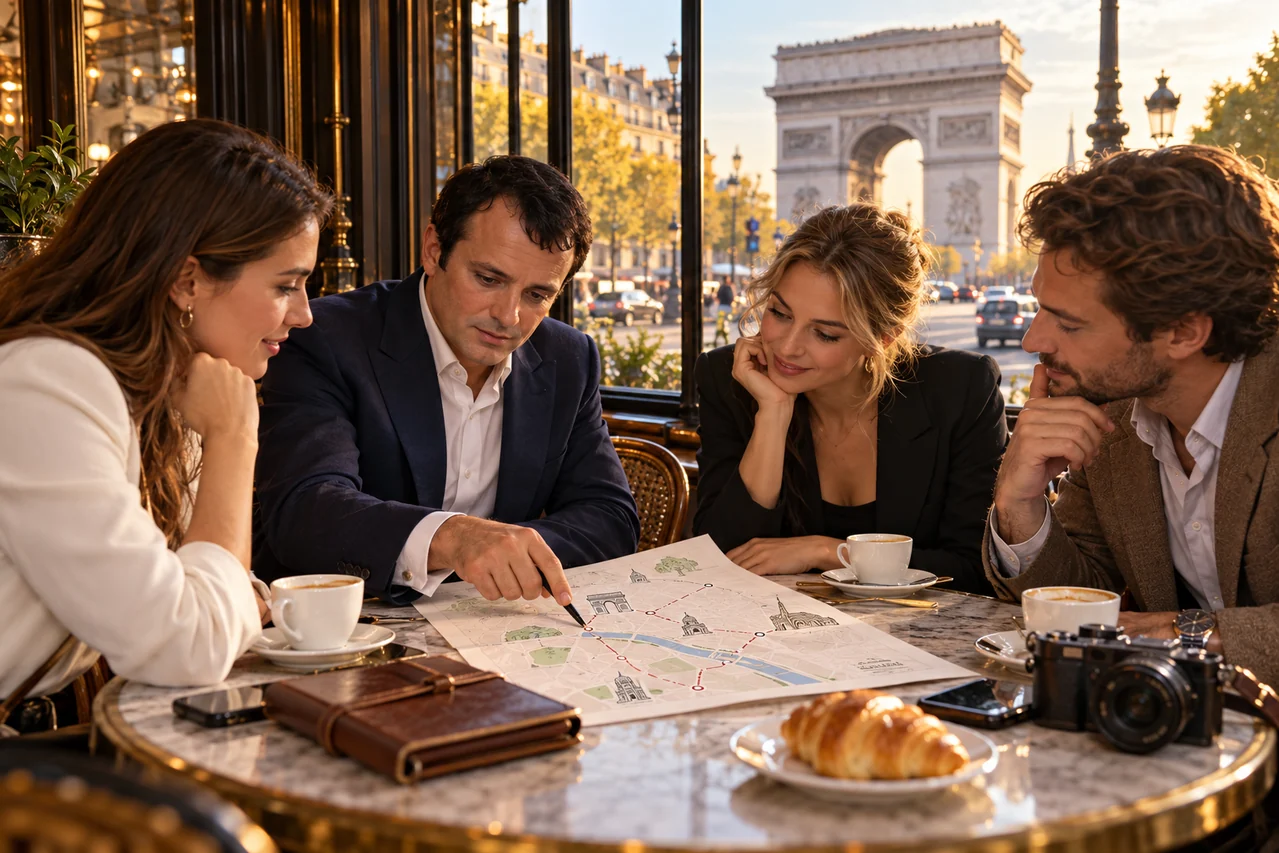
Understand the guests’ interests before choosing the program
Some travelers have read extensively about Napoleon; others know him mainly through films and general culture. Their needs differ. An expert may prefer a specific strategic debate, while a first-time learner needs a clear chronology and vocabulary. Establishing that level helps avoid both repetition and overload. The advisor should also ask whether the interest lies in warfare, politics, institutions or memory. A famous name is a useful starting point, but it does not by itself define what will make the day meaningful.
Choose one narrative thread
A day focused on Napoleon the commander will differ from one about the ruler's use of Paris or the creation of his posthumous legend. A coherent thread makes selection easier and gives each stop a reason to be included. Without it, the schedule can become a sequence of monuments connected only by association. Where his legacy appears in Paris offers possible material, but the purpose is not to see everything. The best route is the one that supports the question guests actually want to explore.
Use the Invalides with a deliberate focus
The military collections and Napoleon's tomb provide substantial historical material in one setting. Their richness creates a temptation to stay longer than the program can comfortably accommodate. Select a focus in advance and allow enough time to engage with it. For an expert, a narrow theme may be more valuable than a general overview; for a family, a few objects and a clear story can work better than exhaustive coverage. Access arrangements and current practical conditions should be confirmed separately during planning.
Change from observation to participation
Elyrea's strategy Encounter introduces a different posture after looking at objects and monuments. Guests can consider choices, limited information and consequences through interaction with a theatrical interpretation of Napoleon. This shift may refresh attention while continuing the same subject. It is not a substitute for museum evidence, and performance should not be treated as independent proof. The formats complement each other: material traces establish context, while character and conversation help visitors examine the decisions that gave those traces historical meaning.
Allow a genuine pause
A historically dense day needs time for rest, food and informal discussion. Lunch does not have to be assigned a forced Napoleonic association to belong in the itinerary. Its role can simply be to create comfort and space between concentrated experiences. This is especially important for multi-generation groups, whose attention and stamina vary. Premium planning includes what is left open as well as what is booked, allowing travelers to process a complex subject rather than move immediately from one demanding account to another.
Add one monument of memory
The Arc de Triomphe or the Vendôme Column can extend the theme from decisions to their public representation. The Arc's layered history includes its commission in 1806, completion after Napoleon's death and later national remembrance. A selected monument gives the day a different kind of evidence from museum collections. It also prevents the story from ending at a battle result. Guests can ask how military events became lasting symbols and how later generations changed the meanings inherited from the imperial period.
Adapt the discussion without distorting history
Families can approach strategy through concrete questions about information and risk. Business groups may find connections with organization, but historical warfare should not be converted into an uncritical manual for contemporary leadership. Experts can examine competing interpretations, while first-time learners need a manageable framework. All versions should retain the human costs of war, authoritarian government and the colonial legacy where relevant. Tailoring concerns emphasis and depth; it does not mean choosing a flattering Napoleon whenever the audience prefers an entertaining subject.
End with a question that joins the day
Why does Napoleon remain so present in French memory? After an intentional sequence of collections, interaction and a monument, guests have material for their own answer. That is a stronger conclusion than one final date delivered during a hurried transfer. The advisor can design the Encounter as the day's pivot or its reflective culmination according to the program. The aim is a coherent cultural experience in which guests understand connections, with enough space to leave curious rather than merely exhausted by historical information.
FOR YOUR GUEST ITINERARIES
Building a Napoleon itinerary for history enthusiasts, families or a private group? Contact Elyrea to discuss where a strategy Encounter can add the most value.
Discuss your itinerary