
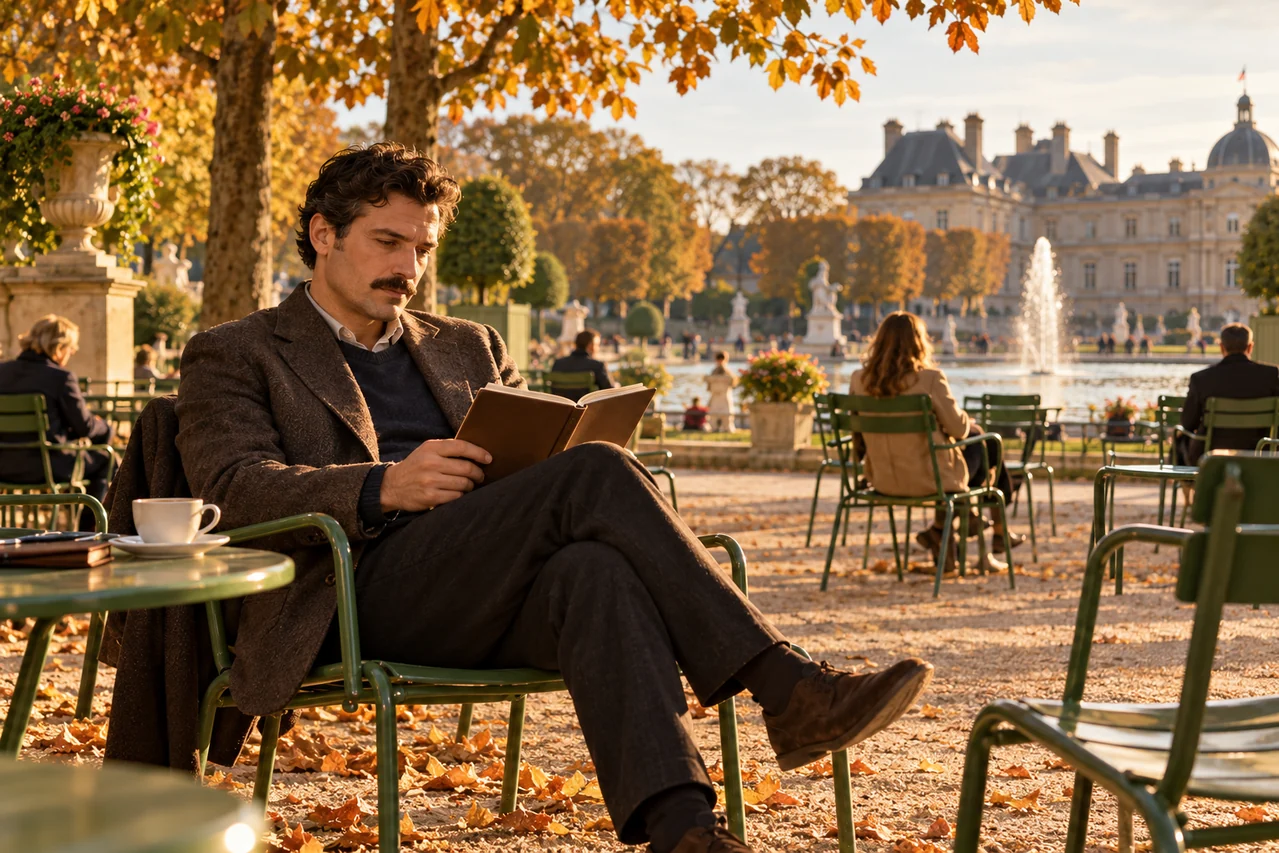
A writer works beyond the desk
Walking can provide space to think, observe and let an idea develop without immediately writing it down. A garden therefore occupies an interesting place between labor and daily life. It is less obviously literary than a bookshop, yet can reveal how attention works. The point is not to claim a specific fictional sentence was composed beside a particular bench. It is to consider why a writer's relationship with a city includes movement and observation as well as rooms where pages were produced.
The Luxembourg belongs to a walkable Paris
The garden sits within the Left Bank geography associated with Hemingway's early life: homes, cafés, books and meetings were linked through ordinary movement. Seeing the distances helps guests understand the city as a place of repeated use rather than a set of isolated monuments. Explore Hemingway's Paris uses that human scale as part of a narrative encounter. The garden can then become a pause within a coherent environment, instead of an extra scenic stop attached to the itinerary without explanation.
Observe everyday life rather than hunt for relics
Children, families, students and walkers make a public garden a place to watch gestures and habits. That offers a concrete way to consider the attention of a journalist or novelist. It does not make every person in a scene the origin of a literary character. Guests can look at the present while imagining the function the space served historically. This approach respects both times: today's Paris remains alive, and the writer's past is approached through a setting rather than falsely reproduced as an unchanged scene.
Hunger belongs to a remembered narrative
In A Moveable Feast, Hemingway's walks and hunger contribute to an image of the young writer's Paris. Those passages are powerful literature, but were produced long after the events. They should not be treated as a comprehensive financial record or proof that all expatriates lived similarly. Why he came to Paris includes relative economic advantages for some Americans alongside real constraints. The distinction lets guests consider hardship without turning it into a romantic badge or a universally shared condition.
Memory creates another version of a place
A later account selects, emphasizes and organizes past experience. The Luxembourg can therefore be approached through two linked questions: what role did it play in daily life, and how did Hemingway later make it part of his remembered youth? Neither question cancels the other. The additional layer makes a literary visit more interesting than simply pointing to a location and announcing that the author walked there. Guests encounter the relationship between a real setting and its reconstruction through writing.
A garden offers a different rhythm
For travelers moving between cultural appointments, the Luxembourg can provide time to slow attention. A literary day does not need every interval filled with commentary. Letting guests look or walk independently can deepen the subject they have just encountered. Families and companions who are less committed readers may also find the ordinary life of the garden accessible. Practical choices should account for the actual group's interests and rhythm rather than assume that a quiet setting automatically suits every traveler.
Connect quiet observation with social exchange
The garden and Hemingway's cafés in Montparnasse represent different functions within the same urban life. One invites a discussion of walking and attention; the other opens work, meetings and literary sociability. Putting them together prevents the itinerary from treating writing as either total solitude or endless conversation. Books and the Odéon can add a third dimension. The value comes from those relationships, not from accumulating every place carrying the author's name.
Keep the encounter and history distinct
Elyrea's Hemingway Encounter uses performance to engage a historical figure in a narrative tied to the city. It does not make a dramatized recollection independent evidence of what happened in the garden. Advisors can frame the experience through questions about creativity, expatriation and remembered place, then leave space for guests' own observations. The result can be a more intimate understanding of Paris, grounded in the difference between a writer's lived environment, the words later written about it and the city encountered today.
FOR YOUR GUEST ITINERARIES
For guests seeking a quieter literary perspective on Paris, our team can help connect the Hemingway Encounter with time around the Luxembourg and a thoughtfully paced Left Bank day.
Discuss your itinerary