
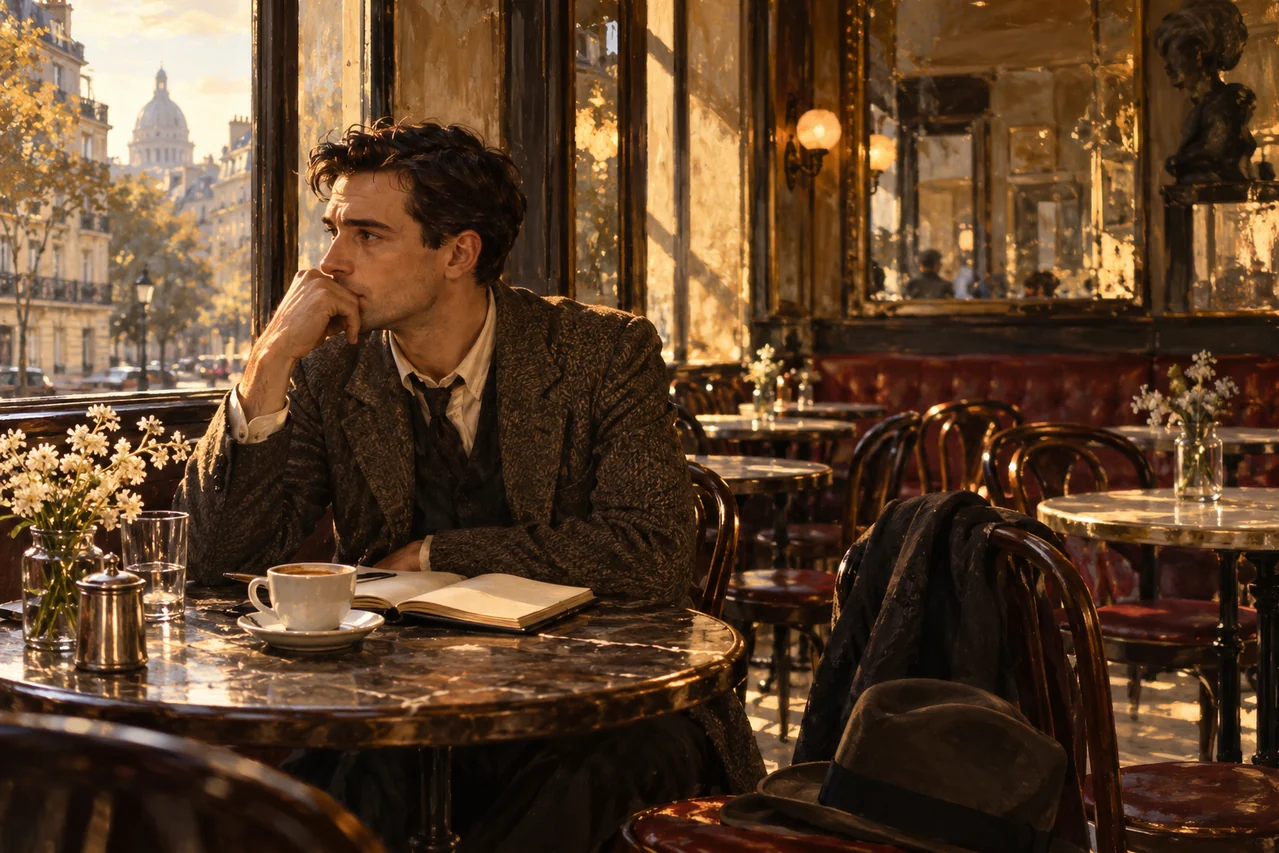
A café could support both solitude and company
A modest home might not provide an ideal table, warmth or an atmosphere for sustained writing. A café offered another working setting, with public life nearby without requiring constant participation. It could also become a meeting place later. This combination makes the historical role more interesting than celebrity patronage alone. For a writer, the same establishment could function differently according to the moment, connecting solitary labor with the social exchanges that helped maintain a creative environment.
The Closerie des Lilas anchors a working story
The Closerie des Lilas is strongly associated with Hemingway and fits the geography between the Luxembourg and Montparnasse. His remembered account helps give it a place in Parisian literary culture. The cultural interest lies in work and setting, rather than a promise to reproduce exactly what he consumed or where he sat. The Luxembourg's quieter literary perspective complements the café, linking observation through walking with time at a table. Both belong to a broader routine rather than separate anecdotal attractions.
The Dôme belonged to a wider community
The Dôme was part of Montparnasse's artistic and expatriate world, where painters, writers and journalists crossed paths. Its importance cannot be reserved for a single famous patron. Thinking about that plurality changes how guests understand a literary café: it was a place in a network, not a personal monument to Hemingway. The environment supported varied conversations and forms of work. An itinerary can explain that shared function without implying every celebrated name was present together or that each encounter became a defining artistic event.
The Rotonde helps reveal a district
The Rotonde likewise belongs within a constellation of social places. People could move between establishments, and the neighborhood's value lay partly in their proximity. For visitors, the connection between cafés may be more revealing than an exhaustive biography of each building. The question becomes how an artistic district sustained interaction. The Lost Generation's network supplies the people and differences behind that setting, keeping a recognizable urban scene from becoming an undifferentiated group portrait of famous expatriates.
Other landmarks need chronological care
Le Select and La Coupole also contribute to Montparnasse's cultural identity, but not every famous café occupied the same place in Hemingway's early Paris years. La Coupole opened in 1927, relatively late in that first period. Dates matter because cultural memory tends to gather establishments into one timeless image. A clear account can include later developments while making the transition visible. It should not imply the young writer arrived in a district already arranged exactly as visitors now imagine it.
Do not let nightlife conceal writing
Alcohol and entertaining stories dominate some versions of expatriate Paris. Those may be part of particular lives, but they do not explain how books were made. Writing required regularity, selection and revision. Hemingway's development as an author helps restore that discipline to the café narrative. The city can remain appealing without turning creativity into uninterrupted leisure. A visitor gains a more human understanding when work, financial constraints, relationships and pleasure all occupy their appropriate places in the account.
Use a café pause for conversation
A meal or coffee in Montparnasse can be a useful continuation after the Encounter if it allows guests to consider the story they have heard. It should not be marketed as an exact reenactment of Hemingway's routine, nor does this article promise a reservation or a particular establishment within the performance. Advisors can choose the arrangement that suits the actual group. The cultural purpose is to give social time meaning within the itinerary, rather than simply add a recognizable name to the day.
Read the present without pretending it is the past
Today's establishments retain associations but operate in a changed city. A narrative visit can explain that difference while letting guests enjoy the places as they are. Explore Hemingway's Paris brings the historical figure into an interactive literary frame, with performance distinguished from documented evidence. The guest leaves not merely knowing that an author frequented cafés, but understanding why this kind of space mattered. That understanding can accompany independent exploration long after the formal encounter has ended.
FOR YOUR GUEST ITINERARIES
For guests interested in literary everyday life, Elyrea can help connect the Hemingway Encounter with Montparnasse and a meal or café pause that serves the narrative.
Discuss your itinerary