
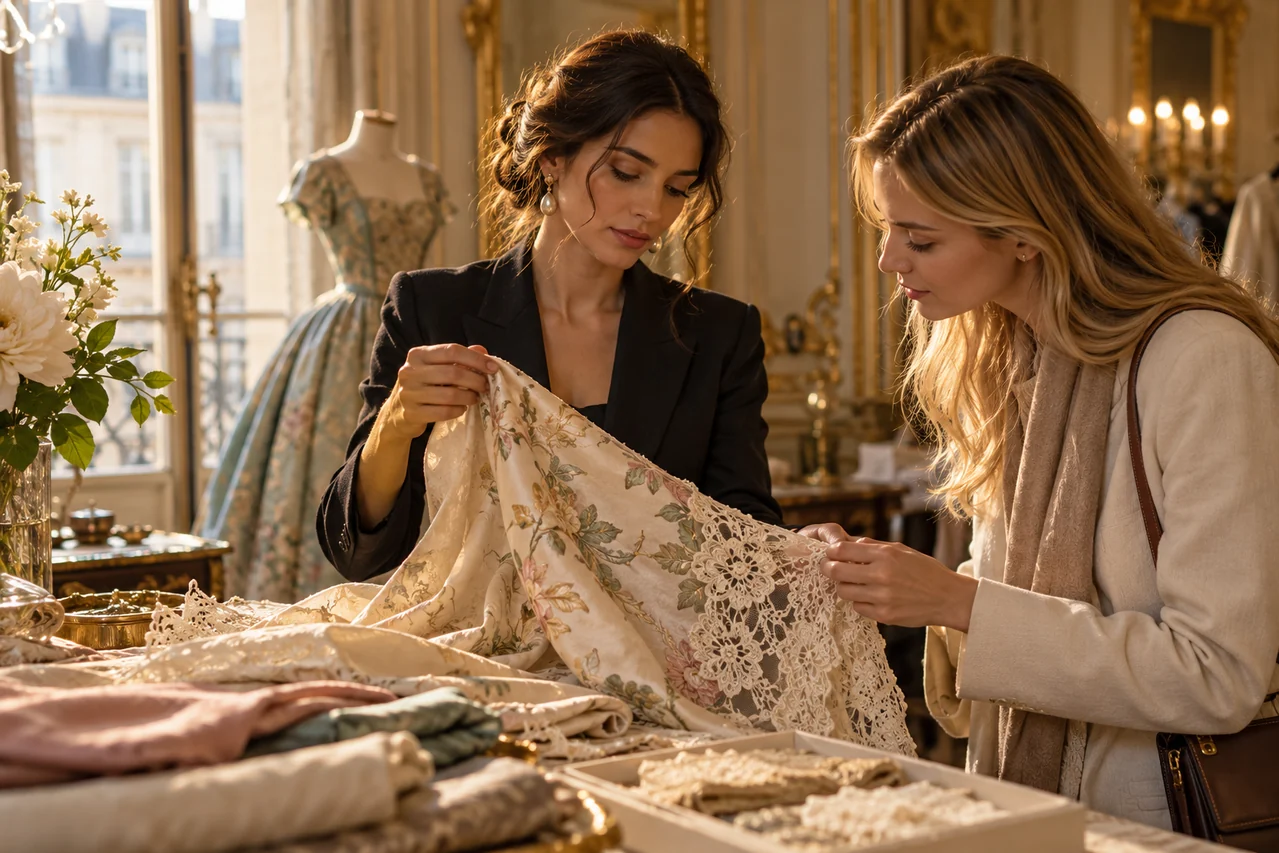
Dress belonged to the work of monarchy
At Versailles, clothing was not merely an expression of individual preference. Materials, jewelry and ceremonial presentation helped represent royal power and supported an economy of prestige. A young dauphine, then queen, was expected to appear appropriately within that system. This context complicates the familiar distinction between necessary court display and personal extravagance. The same garment could fulfill an institutional expectation while exposing its wearer to criticism. Marie-Antoinette's fashion should therefore be read through her role as well as through her tastes.
Rose Bertin and the amplification of influence
Rose Bertin's relationship with the queen is central to the story of her style. As a prominent fashion merchant, Bertin belonged to a wider world of suppliers, skills and innovation. Marie-Antoinette did not invent every trend associated with her, but her visibility gave designs exceptional reach. A look worn at court could become a reference for elites elsewhere. This is how royal status and professional creativity worked together. The fashion icon emerged from an environment, not from one woman creating an entire aesthetic in isolation.
The hairstyle as a public spectacle
Elaborate hairstyles and poufs became part of the period's most recognizable visual language. Ornament, feathers and references to contemporary events could bring the outside world into appearance. These forms are interesting because they show clothing and hair carrying ideas as well as decoration. It is tempting to discuss them only through astonishment at their scale. A more useful account asks why such visibility mattered, who could participate in it and how a spectacular image might invite imitation, admiration or political mockery.
Simplicity could be as controversial as splendor
The chemise-style dress associated with Marie-Antoinette presents a revealing paradox. In a portrait by Élisabeth Vigée Le Brun, a lighter, simpler appearance unsettled expectations of how a queen should be shown. The controversy was not simply about the cost of clothing. It concerned the boundary between royal representation and a more private image. Simplicity did not necessarily free the queen from judgment. Changing the codes could itself be read as transgression, demonstrating that almost any choice became public material once the wearer embodied monarchy.
Trianon connected style with a way of living
Marie-Antoinette's interest in more intimate settings also helped shape the image later associated with her. Interiors, gardens and clothing can be considered together as part of a desire for a different scale of social life. Yet the Hameau should not be reduced to a fanciful story of the queen pretending to be a poor farmer. Understanding the Hameau in its cultural context provides a better framework. The setting belongs to eighteenth-century tastes and royal privilege, as well as to the later legends built around it.
When appearance became an accusation
Clothes and hairstyles offered visible symbols during a period of serious financial and political difficulty. Critics could use them to suggest that the queen was indifferent to the kingdom's problems. Their rhetorical power should not be confused with a complete explanation of the monarchy's finances. War, debt, taxation and blocked reform far exceeded her personal wardrobe as causes of crisis. Why Marie-Antoinette became a target shows how a fashion image could be absorbed into a wider political narrative, making appearance seem to prove character.
The modern icon is another layer of interpretation
Later films, fashion imagery and visual culture have repeatedly returned to a recognizable Marie-Antoinette aesthetic. These uses do not necessarily reproduce eighteenth-century dress with historical precision. They may select colors, volumes or decorative details to communicate a fantasy of the queen. A traveler can enjoy that imagery while asking how it differs from the historical subject. Her continuing presence in fashion therefore belongs partly to the history of reception: the image changes as each period decides what it wants Marie-Antoinette to represent.
Use the royal chapter to open a wider style journey
For an advisor, Marie-Antoinette can introduce a discussion of how clothes become social messages before the itinerary moves into the different worlds of Chanel and Dior. Connecting Marie-Antoinette and Chanel through Paris should compare changing contexts rather than invent a direct lineage. An Elyrea Encounter gives the queen's chapter a human voice, while museums, streets and later designers offer additional perspectives. The result is a fashion journey that goes beyond shopping to examine the changing relationship between appearance, authority and personal expression.
FOR YOUR GUEST ITINERARIES
Planning a French fashion journey for your guests? Our team can help make a Marie-Antoinette Encounter the royal chapter of a wider itinerary alongside Chanel and Dior.
Discuss your itinerary