
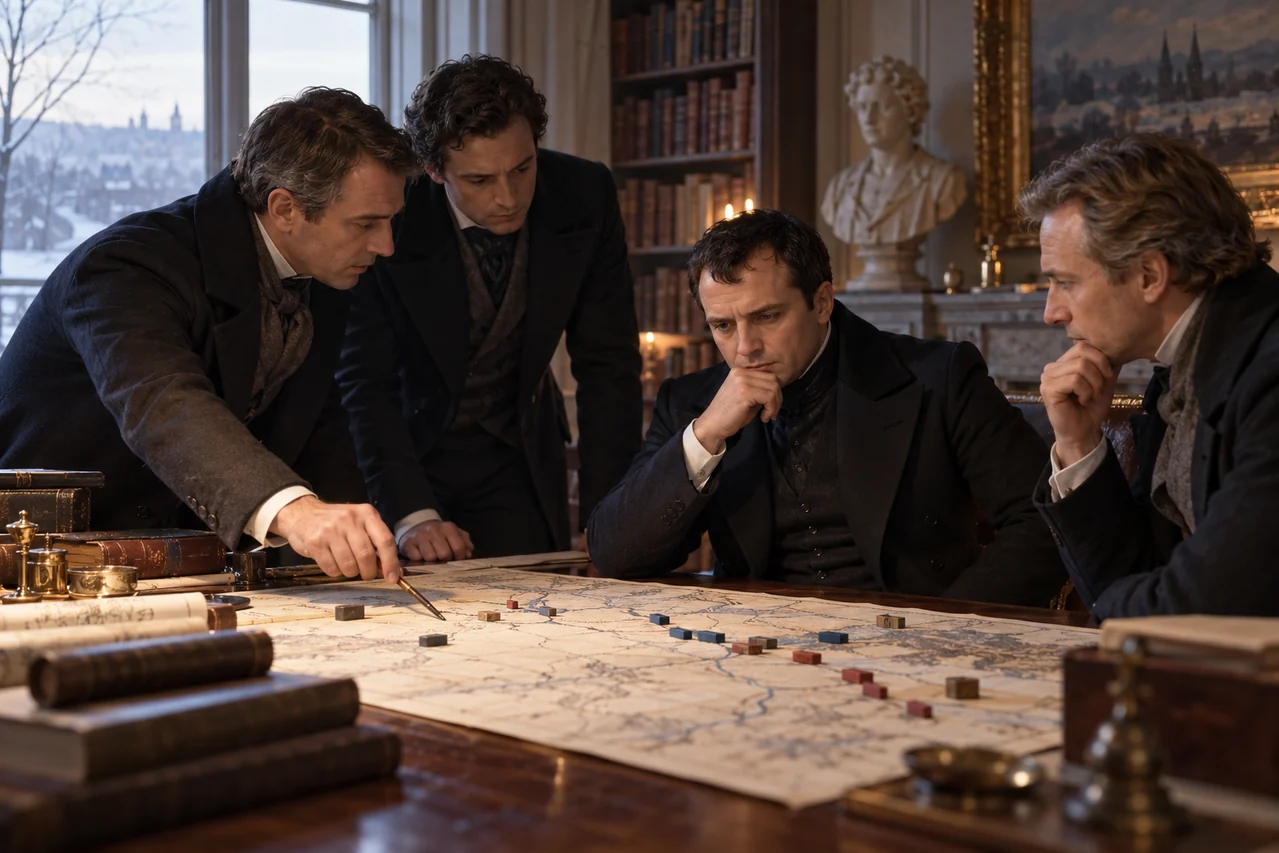
The political aim came before the march
Tensions with Tsar Alexander I, including those surrounding Napoleon's continental economic system against Britain, formed part of the background to the invasion. In 1812, Napoleon assembled an immense army and crossed the Niemen. Its size projected strength, but it also created a demanding material problem. Men and horses had to be fed and supplied over increasing distances. The campaign's difficulties therefore belonged to its political and logistical design before the most severe winter conditions arrived.
Distance changed the supply equation
Methods that had worked elsewhere became harder to sustain across the territories encountered in Russia. Local resources could not simply be assumed to meet the army's needs, and supply lines lengthened as it advanced. Losses and exhaustion began well before the famous freezing retreat. This matters because the winter-only explanation conceals how the army was already weakened. Logistics was not a minor detail accompanying strategy; it shaped what movements were possible and what they cost even when no decisive battle occurred.
Russian resistance had several forms
Russian forces frequently withdrew rather than provide the decisive encounter Napoleon wanted on his preferred terms. Yet they did not avoid battle altogether. Borodino in September 1812 was an exceptionally bloody confrontation. Retreats, combat and the broader response to invasion all affected the French situation. A serious account gives the Russian side agency instead of treating the country as an empty space whose weather defeated an otherwise unstoppable army. Napoleon's opponents could make choices that frustrated his political and operational assumptions.
Taking Moscow did not secure the objective
The occupation of Moscow did not produce the peace Napoleon expected. The city was extensively burned, and Alexander did not conclude the desired settlement. Possession of a place and achievement of a political outcome proved different things. This distinction is central to the campaign's strategic interest. Napoleon had advanced far from his bases with a diminished army, but the event he hoped would resolve the conflict failed to do so. Territorial success could not, by itself, compel the response he needed.
Waiting increased the pressure
Remaining in an uncertain position consumed time and resources while the army's condition deteriorated. Departure did not erase those accumulated weaknesses. The retreat confronted exhausted forces with shortages, opposing action and worsening conditions. Travelers considering the choices should avoid easy hindsight: the historical participants did not know every later consequence. Nevertheless, the situation reveals how delay can alter the range of options. Space, time and material capacity interacted, making it difficult to separate one decision from the pressures created by earlier ones.
Cold was a major factor among several
Severe temperatures played a substantial role, particularly during the retreat. Recognizing that role does not require attributing the entire disaster to winter. Hunger, disease, combat, loss of horses and exhaustion had already reduced the army's capacity. The memorable figure of General Winter compresses an explanation into an image; it is insufficient as a historical account. Napoleon's military system worked under constraints, and in this campaign several of those constraints became mutually reinforcing rather than independently manageable problems.
The Berezina illustrates the limits of shorthand
In French usage, Berezina can mean a disaster. The river crossing itself was more complex: amid a dangerous situation and heavy losses, part of the army escaped encirclement by crossing. The word's later meaning should not substitute for examining the episode. This makes a useful cultural question about memory. A name can summarize a campaign's catastrophe while concealing difficult local achievements inside it, just as a famous victory can conceal uncertainty and suffering beneath an apparently simple success story.
Failure makes comparison necessary
Set beside Austerlitz, Russia shows why past effectiveness does not guarantee future outcomes. Guests can examine whether assumptions about supplies, enemy responses and political results remained sound. Elyrea's strategy Encounter can turn those questions into participation without claiming visitors would easily have done better. For history enthusiasts and decision-minded guests, the value lies in understanding how an operating system reached its limits. The campaign offers a serious study of consequence, not a romantic story of heroic endurance in beautiful winter scenery.
FOR YOUR GUEST ITINERARIES
Building a Paris program around strategy and its limits? Contact Elyrea about exploring the Russian campaign through a Napoleon Encounter for your guests.
Discuss your itinerary