
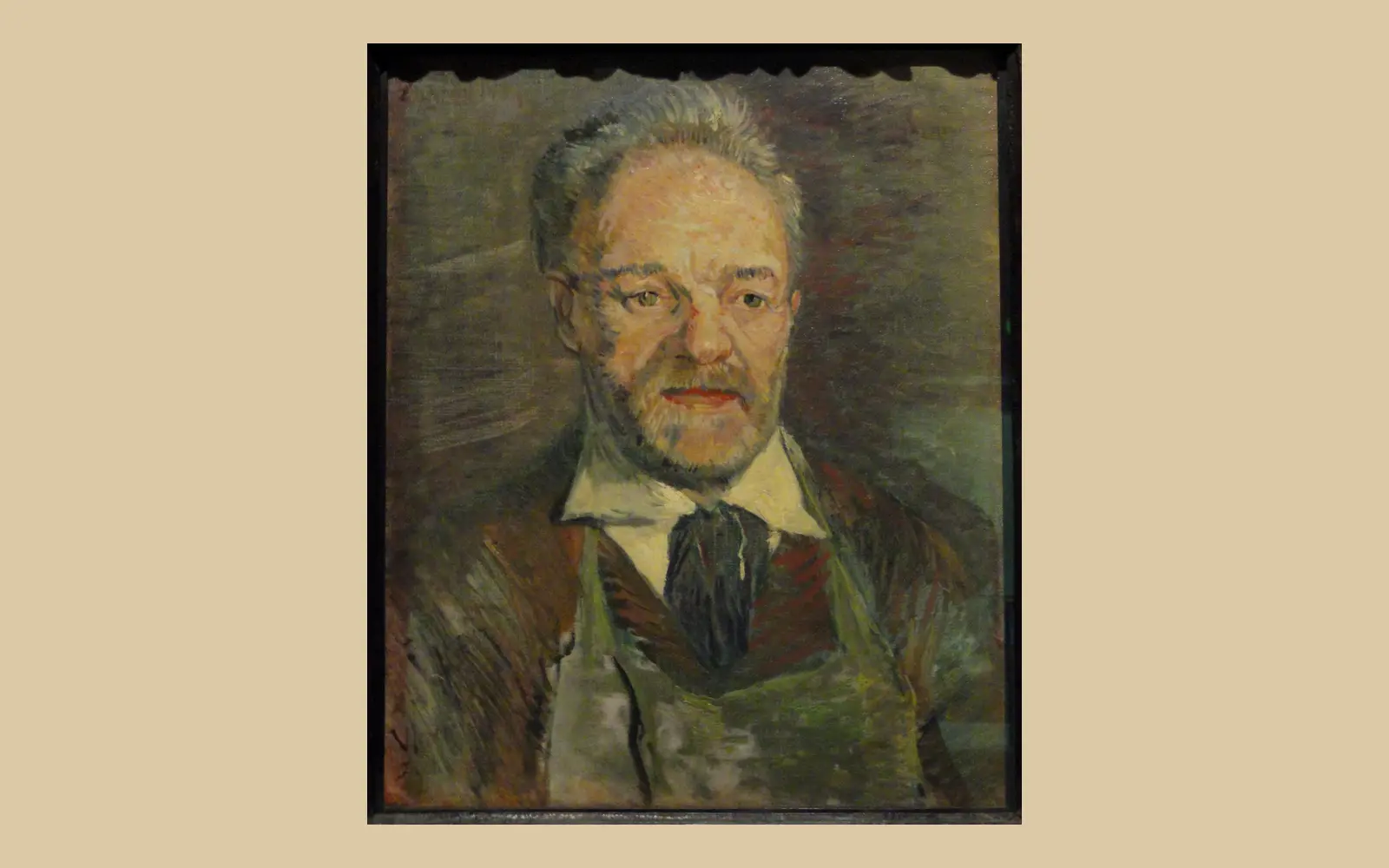
Three portraits capture a rapid transformation
The Musée Rodin confirms that Vincent van Gogh made three portraits of Julien Tanguy: an initial version in 1886–87 and two more in 1887. Considered together, they record a striking change. The sitter remains the patient color merchant known as Père Tanguy, while palette, pictorial space and the way his presence is constructed shift dramatically during Van Gogh’s Paris years.
The sitter was part of the artists’ working world
Julien Tanguy sold pigments, canvas and supplies, occasionally accepting paintings when artists could not pay in cash and displaying work in his shop. The story of Père Tanguy is therefore not a society portrait. Van Gogh painted a quiet participant in the infrastructure of art, someone whose credit and confidence could matter before either dealers or the public recognized a painter.
The first portrait still looks north
The first canvas, now at the Ny Carlsberg Glyptotek in Copenhagen, is dated January 1887. The Musée Rodin describes its broad handling and ocher, earthbound range as indebted to Dutch Golden Age models. The background is restrained. Tanguy wears his work apron and meets the viewer directly, as though Van Gogh first established the dignity of the trade before reinventing the visual world around him.
Japanese prints enter the later pictures
The next two 1887 portraits adopt purer color and sharper contrasts, while reproductions of Japanese prints cover the background. They are not arbitrary exotic decoration. Van Gogh and his brother Theo collected such prints, and Tanguy sold them in his shop. Japanese imagery in Père Tanguy’s world signals the circulation of visual ideas that helped European painters rethink color, contour and space.
A still figure anchors a restless setting
In the portrait held by the Musée Rodin, Tanguy sits frontally with folded hands, almost motionless. Around him, saturated colors and printed images move in multiple directions. The contrast holds the composition together: the sitter’s stability gives the eye a center while the background stages experiment. The museum emphasizes the kindness and modesty Van Gogh captured rather than turning Tanguy into a theatrical hero.
The color merchant becomes a kind of sage
The Musée Rodin suggests that the print-filled version presents Tanguy almost as a Japanese sage. That does not mean the sitter is impersonating an Asian character. It describes how Van Gogh connected his composure, generosity and role as a facilitator with a visual culture he admired. The supplier who ground and sold color becomes the calm center of the new pictorial language he materially helped artists pursue.
The paintings also reveal how reputations are built
Tanguy never parted with the version now in the Musée Rodin. After his death in 1894, it entered the market and was purchased by Auguste Rodin. That path is a reminder that recognition was neither immediate nor inevitable. Color merchants and the making of modern art belonged to a world of informal credit, exchange, advocacy and pictures preserved for years outside public institutions.
B2B guidance: compare before interpreting
For art-focused clients, begin with the earth-toned first portrait, then introduce the Japanese prints and pure colors of the later versions. Comparison makes Van Gogh’s Paris learning visible without reducing it to an overnight conversion. The Elyrea Père Tanguy Encounter can extend that reading of Montmartre’s artistic networks, subject to separately confirmed availability.
FOR YOUR GUEST ITINERARIES
With Elyrea, see how Père Tanguy’s face opens a story about the networks, materials and visual exchanges behind modern art in Paris.
Discuss your itinerary