
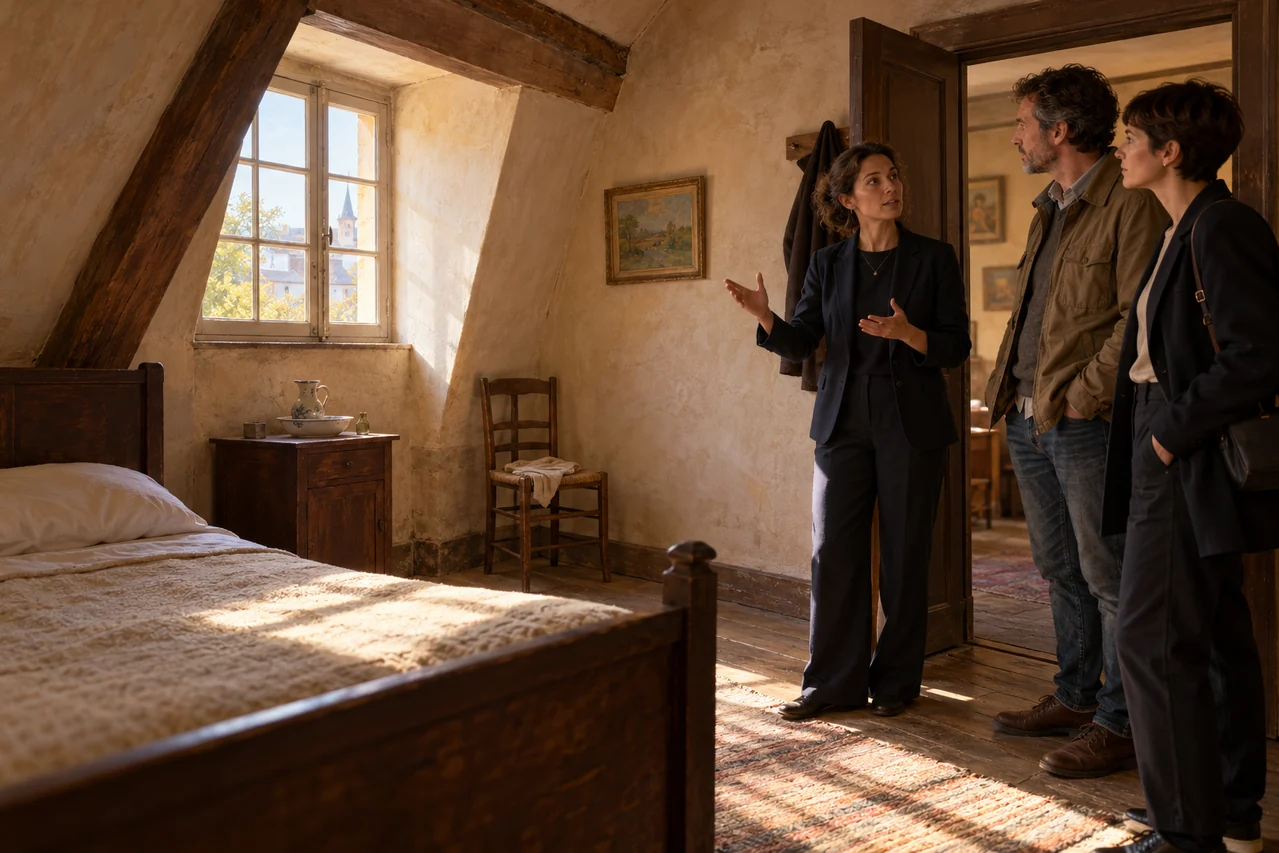
Modest accommodation supported a working routine
An inn gave Vincent a place to live while he pursued subjects around Auvers. Its significance begins with those ordinary needs. A room is not an explanation of the paintings, but it helps visitors imagine the structure of a day: preparing to leave, working in the village or landscape and returning. The domestic setting keeps the account close to a person, rather than allowing the famous name to float above the practical circumstances of making art.
The room became famous afterward
Visitors encounter a place whose significance has been transformed by Van Gogh's later reputation. That later recognition should not be projected back onto every aspect of his life in 1890. The modest scale is especially striking because guests bring knowledge of museums and worldwide acclaim. The contrast can raise questions about how posterity changes an ordinary location into a site of memory. It does not require pretending that contemporaries already saw the room in the way visitors see it now.
The simple setting challenges a market-driven image
The value now associated with Van Gogh's paintings can overshadow the actual conditions of his life. The inn returns attention to a room, a daily routine and the dependence on support from other people. This does not justify the opposite myth that he was wholly unknown to everyone who mattered. Artists and contacts did recognize aspects of his work. The useful contrast is between the scale of his contemporary circumstances and the extraordinary expansion of his later public reputation.
The work took him beyond the room
A visit should connect the inn with the landscapes, houses and church Vincent painted. The room was a place of return, not the whole environment of his creativity. His remarkable production at Auvers shows why the surrounding village deserves equal attention. Following that connection also helps prevent the room from becoming only an object of sadness. Guests can picture an active painter moving between accommodation and subjects through the day.
The inn also belongs to other people's lives
The history includes the owners and the people around Vincent, not merely the isolation suggested by a small room. Their presence helps restore the social setting without inventing intimate conversations or precise scenes for which evidence is lacking. A theatrical interpretation can convey ordinary relationships while distinguishing narrative reconstruction from verified biography. The aim is to make the place humanly comprehensible, rather than treat every person near the artist as a supporting role in a prewritten legend.
The final events require a careful distinction
Vincent returned wounded in July 1890 and died at the inn with Theo nearby. The traditional account of suicide remains the dominant account, while the circumstances have attracted debate. The room's association with death does not justify elaborate reconstruction or a claim to certainty about every detail. What can be said about Van Gogh's death explains the need to separate established events, reported testimony and later hypotheses without selecting the most dramatic version for effect.
Restraint can deepen the experience
A small, quiet setting may leave a strong impression precisely because it avoids monumental display. Guests can reflect on the distance between the person and the icon without being told what emotion to feel. Advisors should give the place room within the day and avoid moving immediately from one intense memorial subject to another. Any interior visit is a separate practical arrangement whose conditions need confirmation; the cultural significance should not be presented as a promise of special access through the Encounter.
Return from remembrance to the paintings
The best continuation leads back to what Vincent made. After considering the room, a visitor may look differently at a village view or a portrait, recognizing the ordinary circumstances around an extraordinary practice. An Auvers Encounter can help make that transition through questions about daily work and observation. The inn then contributes to a full artistic journey: home, subjects, relationships and memory are connected, while none is allowed to reduce the artist to the fact of his death.
FOR YOUR GUEST ITINERARIES
For guests seeking a human understanding of Van Gogh, our team can help connect the Auberge Ravoux's historical significance with an Auvers Encounter and a wider artistic day.
Discuss your itinerary