
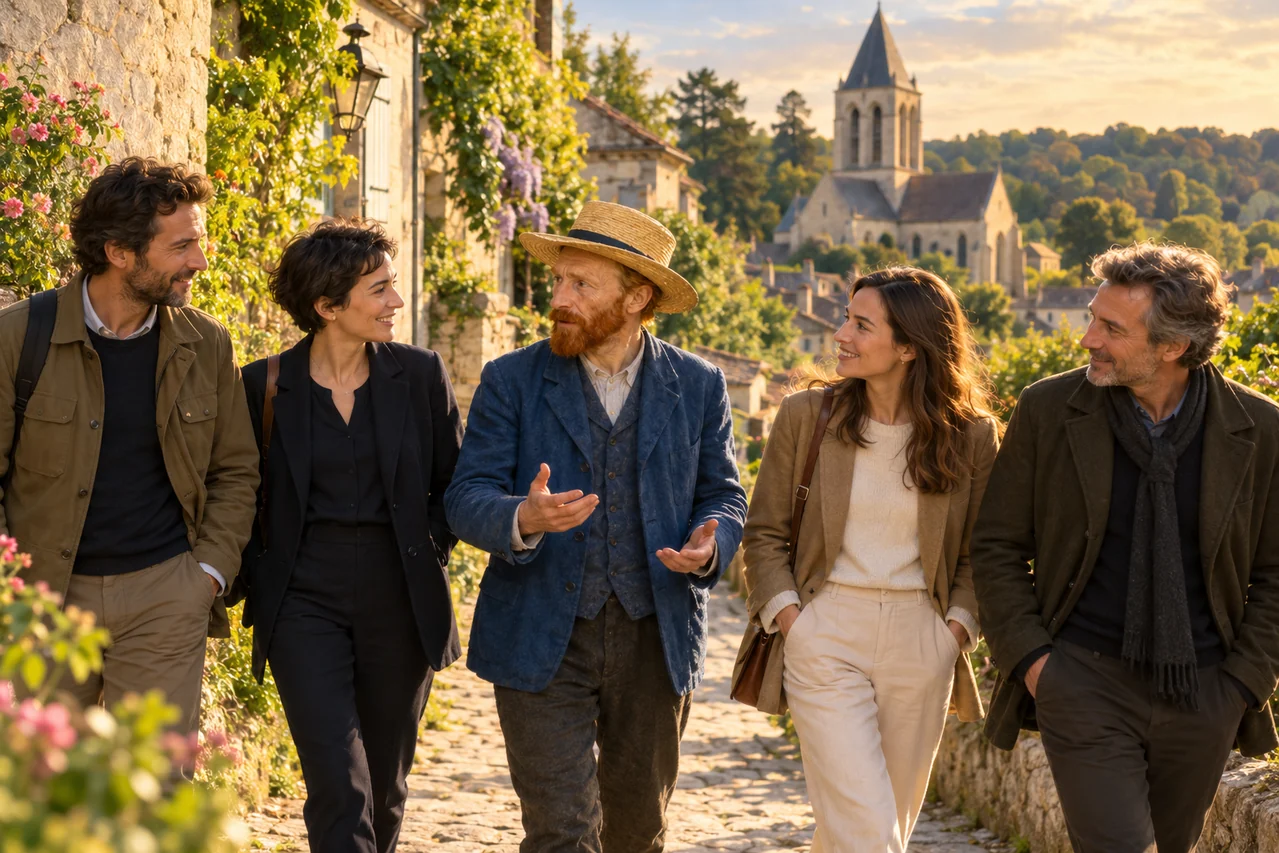
Auvers was a place to continue working
Van Gogh arrived in May 1890 after his stay at Saint-Rémy. The village offered a rural setting, proximity to Paris and Theo, and the presence of Doctor Gachet. These were reasons to pursue life and painting, not to choose a location for an inevitable ending. Beginning with the possibility of a new chapter changes the visitor's perspective. The later tragedy remains part of the history without determining the meaning of every moment before it.
The village already had an artistic history
Auvers was not an anonymous landscape waiting for Van Gogh to make it significant. Artists including Daubigny had established connections with it. That context helps explain its appeal and gives visitors a broader understanding of the relationship between villages near Paris and nineteenth-century painting. Van Gogh entered an existing artistic geography, then transformed its subjects through his own choices. The difference between the place and his treatment of it is a central part of the excursion.
The Auberge Ravoux returns the icon to human scale
The modest accommodation associated with Van Gogh contrasts with the worldwide recognition of his paintings today. It can help visitors imagine the ordinary structure of a working life: sleeping, eating, leaving to paint and returning. That domestic scale matters alongside the art. The Auberge Ravoux and his last home offers a deeper continuation, placing the room within a daily routine rather than presenting it only as the setting of his final hours.
Look from the church to the painting
The church offers a recognizable subject against which visitors can consider the artist's transformations of line, color and perspective. The purpose is not simply to find an exact photographic match. Comparing a familiar painting with the site reveals decisions about what was emphasized and how the view became an image. A guest who knows little art history can begin with these visible differences, while an experienced reader can connect them with the broader development of Van Gogh's work.
The fields belong to creation as well as memory
The surrounding landscapes can evoke famous paintings, but the visit should avoid reading every field as a direct announcement of death. Pictures are not coded medical reports or automatic statements of intention. In particular, Wheatfield with Crows should not be presented as definitively the last work or proof of what followed. The visitor can appreciate rhythm, space and color while acknowledging that later biographical knowledge strongly influences how the same image is interpreted.
Gachet and Theo make the human network visible
Doctor Gachet's roles as physician and art enthusiast, together with Theo's support and relationship with Vincent, complicate the familiar image of the utterly isolated painter. Those connections do not eliminate vulnerability, but they show that the life was lived among other people. A serious account keeps the artist's own work at the center while explaining the network around him. The geography of Auvers becomes more legible when places are connected with those different relationships.
Approach death and remembrance with restraint
Van Gogh died on 29 July 1890 after returning wounded to the inn. The traditional account describes suicide, while circumstances have been debated. That distinction should be stated without turning the visit into an attempt to solve a sensational mystery. The cemetery, where Vincent and Theo lie together, calls for respectful behavior and a separate consideration of family memory. It is a chapter in the excursion, not the explanation of all the paintings made beforehand.
Let the Encounter connect work and place
Van Gogh’s Last Days in Auvers-sur-Oise brings an embodied artist into conversation with the village and its landscapes. The theatrical interpretation can encourage questions about looking, making and the ordinary conditions of creation. An advisor may use a focused Auvers itinerary to place it alongside independently arranged visits. The strongest journey returns attention to the paintings, giving guests a deeper relationship with the work rather than merely a collection of biographical locations.
FOR YOUR GUEST ITINERARIES
For guests passionate about Van Gogh or the relationship between art and place, Elyrea can help integrate Van Gogh’s Last Days in Auvers-sur-Oise into their journey from Paris.
Discuss your itinerary