
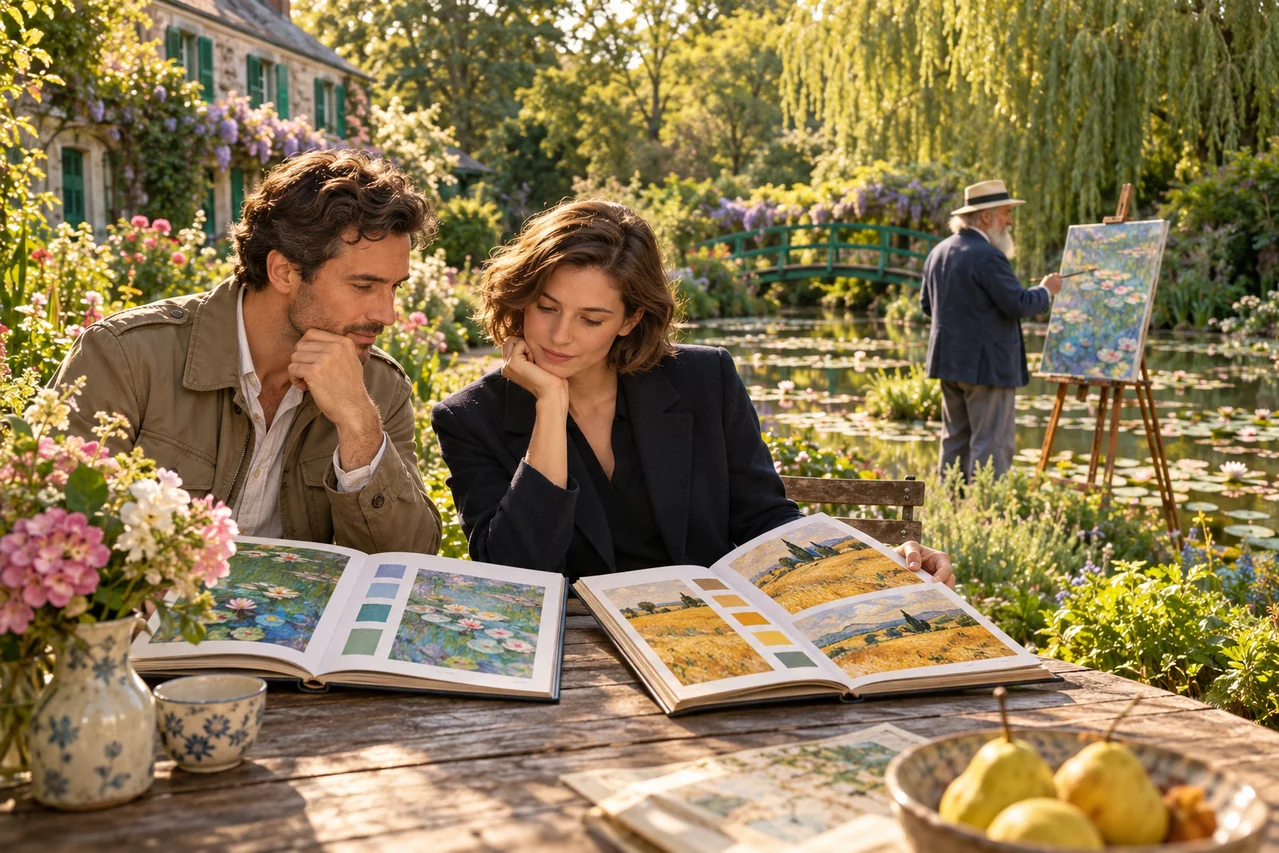
Time creates the first important contrast
Monet lived at Giverny from 1883 until 1926, allowing decades of development and observation. Vincent's Auvers stay lasted from May to July 1890 and produced a remarkable concentration of work. This difference shapes the narrative of each destination without deciding its value. Giverny invites consideration of a place transformed over time; Auvers invites attention to a painter rapidly responding to a new environment. Both require room for looking, even though their biographies move at different speeds.
The landscapes entered the art differently
Monet partly created the environment he repeatedly painted through gardening and development of the water garden. Vincent worked with a village, church, houses and fields he had not designed. The transformation at Auvers occurs primarily through the paintings; at Giverny it also occurs through the making of the place. This gives guests a concrete comparison that can be understood without extensive art knowledge. The question is how an artist relates to a subject before and during the process of turning it into an image.
For an Impressionist interest, Giverny is more direct
Monet was a central figure in Impressionism, so Giverny fits a guest whose main passion is that movement. Van Gogh should not be described as an Impressionist simply because he learned from its artists and encountered their works. Auvers can nevertheless add a valuable later perspective within a wider artistic journey. The distinction makes the itinerary more accurate and more interesting: influence becomes a relationship to explore rather than a reason to place every familiar nineteenth-century painter under one label.
Garden and observation interests point toward Monet
A guest passionate about planting, horticultural composition or reflections may find Giverny especially rewarding. The art can grow out of that interest rather than be imposed as the only subject worth discussing. Monet's gardens as a created landscape develops this approach. Photographers may also respond to changes in framing, water and season, although the actual visual conditions vary. The cultural explanation should not promise an identical garden image for every guest or every visit.
Biography and relationships can draw a guest to Auvers
The inn, Gachet's connections, painted subjects and the neighboring graves of Vincent and Theo provide a concentrated human geography. The visit should still begin with work and life rather than become a journey defined entirely by death. Planning a substantive Auvers day offers a framework for that balance. For travelers who already know Van Gogh's paintings well, the physical proximity of subjects and relationships may add more than a general introduction to another artistic movement.
Families and collectors need more specific questions
Neither destination is universally better for a family or an experienced art traveler. Younger guests may enjoy comparing a painting with a real subject, or looking at reflections and color. Collectors may want reception, markets and the networks behind reputation. The advisor should ask about those interests rather than rely on demographic labels. Both Encounters can make room for interaction, but the strongest choice is the one whose subject gives the group a shared and meaningful point of entry.
If both fit, separate their cultural roles
A wider journey can begin in Paris with Père Tanguy and artistic networks, continue to Auvers and then explore Giverny. Each chapter should have enough space to retain its purpose. Combining famous destinations within a single day is not automatically a richer experience. The advisor can choose timing and sequence according to travel conditions and the guest's attention, ensuring that the comparison develops through observation rather than a rushed list of sites recognized through a car window.
Select the relationship with art, not the bigger name
The useful final question is what the guest wants to experience: a garden becoming a sustained artistic world, an intense period of work in a village, or the comparison itself. Inside Claude Monet’s Giverny and Van Gogh’s Last Days in Auvers-sur-Oise offer distinct character-led approaches to those interests. A later museum viewing can continue the inquiry. The recommendation gains credibility when the advisor can explain why this destination, at this point in the trip, will deepen the guest's understanding of art.
FOR YOUR GUEST ITINERARIES
Our team can help you choose a Monet or Van Gogh Encounter according to your guests' interests, or connect both destinations within a carefully paced artistic journey.
Discuss your itinerary