
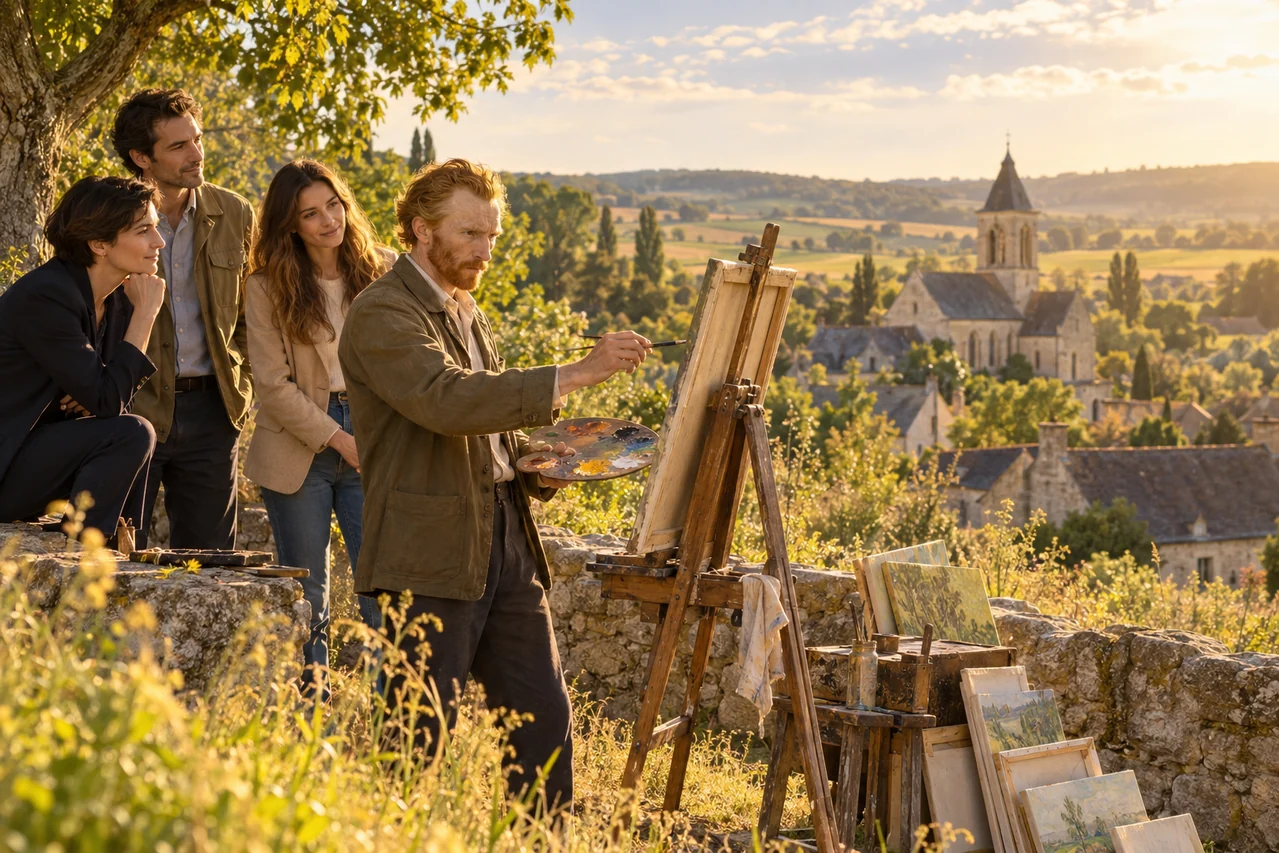
An experienced painter arrived in the village
The Auvers period did not begin with a novice discovering painting. Vincent brought years of work, experimentation and sustained attention to artists before him. His ability to produce intensively rested partly on that developed practice. Speed should therefore be considered alongside experience rather than treated as a mysterious eruption. Guests can see the period as a continuation of artistic questions shaped elsewhere, now pursued through the church, houses, gardens and fields of a new setting.
A concentration of subjects supported daily work
Auvers offered accessible rural and village motifs within a relatively concentrated environment. That proximity mattered to an artist who moved between accommodation and subjects. The range also prevents the output from appearing monotonous: houses, portraits and landscapes posed different problems of form and color. An excursion can make that variety visible. The visitor sees not just a large quantity of paintings, but a sequence of decisions about what to look at and how to organize it within an image.
Materials and outdoor practice were part of the conditions
Portable painting materials and established practices of working before a motif helped nineteenth-century artists pursue subjects outdoors. These conditions belong to the explanation of Vincent's work, although they are not sufficient to account for its character. Many artists shared materials without producing the same images. Père Tanguy's place in the artistic network provides a useful Parisian continuation, connecting the practical world of colors and supplies with the human relationships around new painting.
The Impressionist connection needs a distinction
Van Gogh learned from contemporary painting and encountered Impressionist work, but he should not be described as an Impressionist himself. His treatment of color, line and emotional intensity developed in a different direction. Keeping that distinction allows visitors to appreciate influence without collapsing several artistic histories into a single movement. It also strengthens a wider itinerary: Monet and Van Gogh can be connected through questions of landscape and modern painting while retaining the differences that make the comparison valuable.
Formats and subjects reveal deliberate choices
The elongated landscape format, the church and the views of houses offer ways to discuss structure rather than only emotion. How does the shape of the canvas change a view? Which lines gather attention? What does color do that a literal description would not? Such questions help travelers see active decisions in the work. They also counter the notion that painting rapidly means painting without thought, or that an intense image must have emerged in a single uncontrolled moment.
Letters make part of the invisible workshop accessible
Vincent's correspondence offers insight into what concerned him and how he discussed painting. It can be read alongside the images, while remembering that a letter is a communication from a particular moment rather than an objective report of an entire mind. The writing helps restore the painter as someone thinking about work, materials and relationships. It is a more reliable starting point than assuming that later viewers can decode every color as a direct sign of psychological state.
The last-painting question can distort the period
Wheatfield with Crows is often treated as a definitive final image and interpreted as a warning of death. Neither the certainty about its place in the sequence nor the claim that it proves intention should be accepted casually. The desire to identify a last work can impose a concluding message on a creative period that contained many investigations. The paintings deserve attention for their subjects and artistic decisions, even where chronology remains a question rather than a dramatic answer.
Compare different relationships with a landscape
An Auvers visit lets guests move from an image to its subject and back again. A continuation to Monet's approach at Giverny offers a productive contrast: Monet transformed a garden over decades, while Vincent worked intensely within a village during a short stay. Neither pattern determines artistic value. Their differences help explain the role of time, place and practice in creation, giving an advisor a richer basis for an artistic journey than a simple sequence of famous names.
FOR YOUR GUEST ITINERARIES
For guests fascinated by creative process, Elyrea can help connect an Auvers Encounter with close observation of the subjects and decisions behind Van Gogh's late work.
Discuss your itinerary