
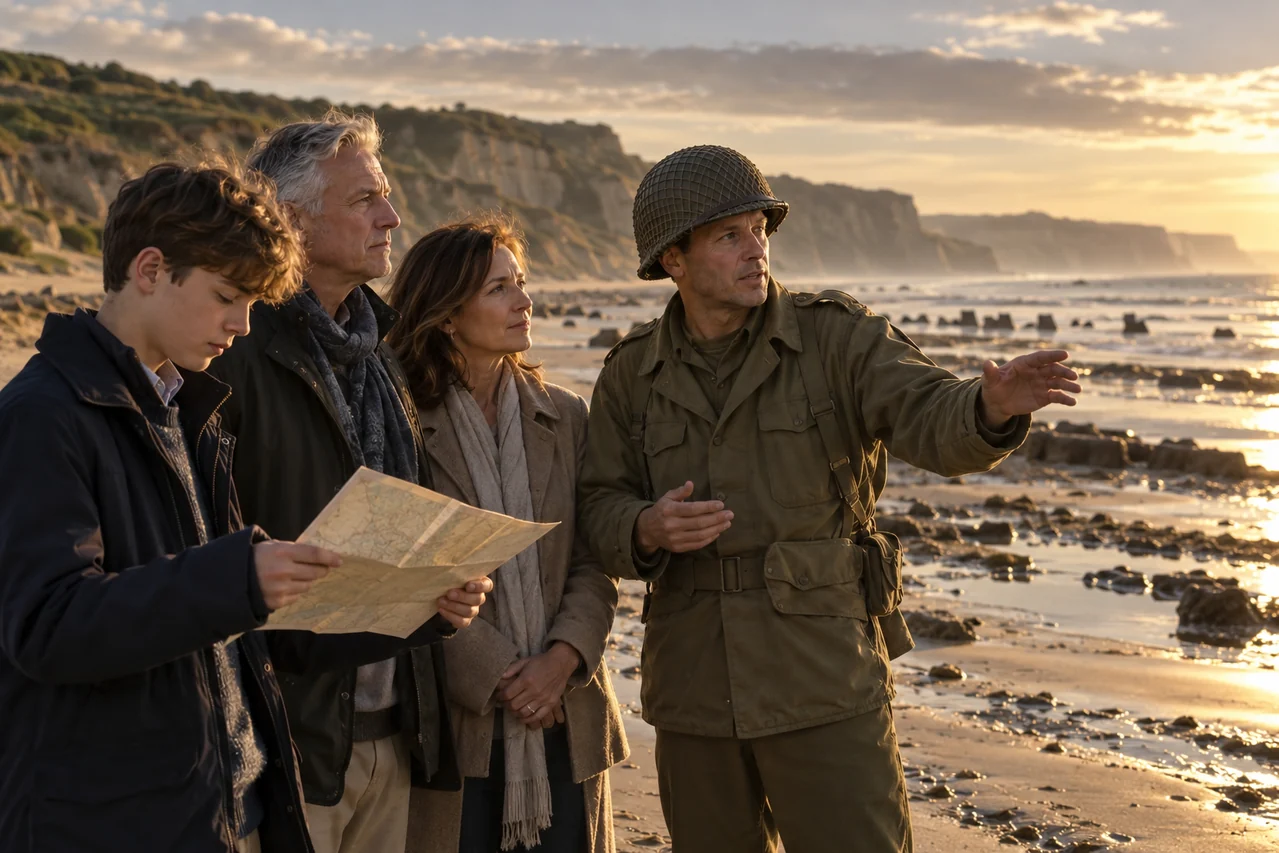
Begin at a scale a young visitor can grasp
Large numbers and operational names can feel remote before their meaning is established. Beginning with one person's immediate circumstances gives the learner a more tangible set of questions: what could he see, what did he carry and where was he meant to go? Charles provides that narrative entry within the Elyrea Encounter. He is not a replacement for the varied real histories of participants. The useful progression begins with an accessible perspective and then expands, rather than expecting young travelers to understand the entire operation before anything feels concrete.
Expand from the individual to the wider event
Once attention has a human focus, the explanation can move toward Omaha, the five landing beaches and the broader Normandy campaign. Overlord and Neptune's different scopes help make that expansion clear. The aim is a connected framework, not a rapid lesson in every military abbreviation. Younger guests benefit from seeing how one task belonged to a collective undertaking. This also prevents an individual narrative from becoming the whole story, preserving the roles of naval forces, airborne troops, logistics and other Allied participants within an intelligible larger picture.
Use the ground to invite practical questions
Why do the heights matter? Why was moving off the beach necessary? How far is the water from a possible route inland? Such questions make the terrain active in learning. They allow young travelers to reason from what they can observe, with historical explanation adding the conditions that are no longer visible. A peaceful walk cannot recreate combat, but it can reveal why movement was difficult. Reading Omaha's landscape provides a method that works without requiring prior specialist knowledge or a constant stream of dates.
Restore uncertainty to a history whose outcome is known
Young visitors often know that the Allied effort succeeded before they arrive. Soldiers on the morning of 6 June did not share that retrospective certainty. Explaining the gap helps make risk and decision-making understandable. It also complicates the heroic image of people acting without fear or doubt. A narrative can show limited information and the need to adapt, rather than promise the sensation of battle. This gives courage a human meaning while keeping the discussion anchored in the difference between looking back at an event and participating as it unfolds.
Participation should develop understanding, not trivialize violence
Questions, observations and comparison can engage a family without rewarding imaginary destruction or turning the battlefield into a competitive game. The seriousness of the site does not demand passive learning, but it does shape which forms of interaction are appropriate. An embodied Encounter can prompt thought about movement, information and responsibility. Adults can help younger participants distinguish dramatic interpretation from documented evidence. That distinction adds intellectual value: an engaging story is a starting point for inquiry, not automatically proof of exactly what every soldier experienced.
Let several actual voices complicate the picture
Letters, testimony and recorded memories can provide different individual perspectives when used with their context. One account does not describe everyone, and a powerful narrative should not erase variations of circumstance. The same principle applies to Charles's performed viewpoint. Families can discuss what each source allows them to know and what remains beyond it. This is an accessible introduction to historical thinking because the question is practical: who is speaking, what did that person encounter and how does the account relate to the wider events being explained?
Include civilians and the continuing campaign
D-Day belongs to the liberation of occupied Europe, while the Normandy fighting also caused civilian deaths and destruction. Younger travelers can understand that war involves more than opposing armies when the information is carefully paced and appropriate to age. The story should also continue beyond reaching shore: the campaign required further action and brought further costs. This broader perspective avoids an ending that celebrates arrival without acknowledging consequences. It allows families to connect military history with the experiences of communities and with the responsibility of remembering more than one part of the past.
Measure success by the questions that continue afterwards
A multigenerational day works when grandparents, parents and younger guests have enough shared context to talk about what they have seen. They need not remember identical details or feel the same response. Time for rest, reflection and conversation matters as much as the Encounter itself. Advisors should match pace and depth to the group rather than maximize the number of stops. The most meaningful result may be a question asked after leaving Omaha: how do we know, why did people act and what should we choose to pass on?
FOR YOUR GUEST ITINERARIES
Designing a Normandy visit for several generations of guests? Elyrea can help you integrate the Encounter with Charles into a day that encourages younger travelers' understanding while respecting the site.
Discuss your itinerary