
Preparation changes how the landscape is encountered
Without context, Omaha can first appear to be an attractive Normandy beach. Explaining the landing, the heights and the routes inland changes how guests read it. This is a form of respect because it attends to what happened rather than treating the location only as a scenic background. Preparation need not mean a lengthy lecture delivered before arrival. A few clear relationships can give travelers questions to pursue on the ground, allowing the place itself to help them understand distances and movement.
Match the interpretive tone to a site of loss
An embodied narrative can bring history closer without pursuing excitement for its own sake. Artificial shocks, triumphalist language and graphic spectacle can distract from the site's commemorative nature. Charles's narrative perspective is most useful when it helps participants understand limited information, vulnerability and action, rather than promising the sensation of being in battle. The distinction protects both the historical experience and the people remembered there. Cultural depth comes from intelligible context and thoughtful attention, not from competing with the emotional intensity of a war film.
History and remembrance ask related but different questions
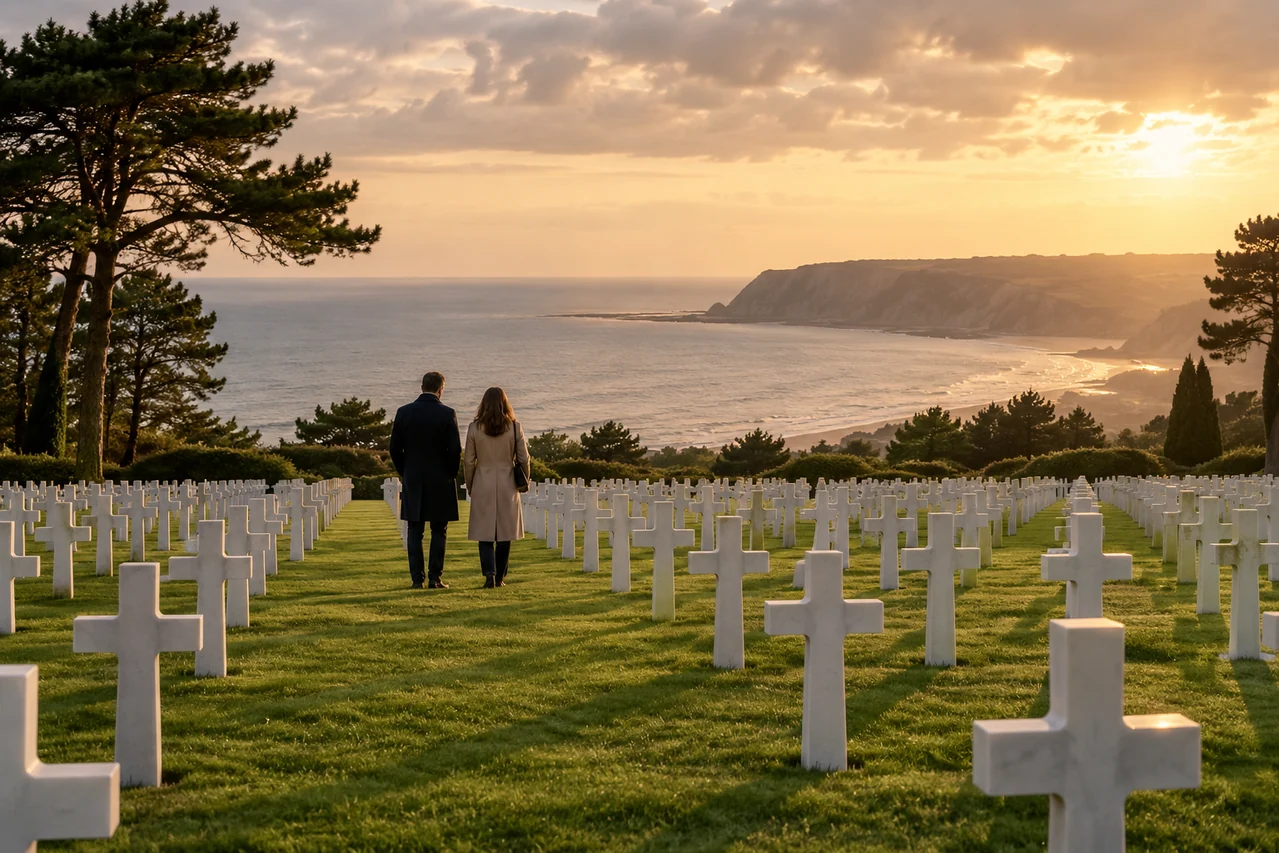
Historical analysis considers events, causes and evidence; remembrance concerns how people and communities hold those events in memory. Omaha can support both, but a tactical viewpoint and a cemetery visit should not be approached in exactly the same way. Guests may need to shift from following movement across the terrain to considering individual lives and loss. A coherent Omaha day allows that transition. Recognizing the different functions of places prevents every stop from receiving the same stream of military explanation regardless of its meaning.
Allow silence to be part of the itinerary
Not every meaningful moment needs interpretation. Time to look, reflect or attend to a particular name can be essential, especially for those with a family connection to the conflict. An advisor cannot assume the same response from all American visitors or all descendants of veterans. Asking about expectations before the visit helps create room for individual needs. Silence should not be awkward spare time inserted after an overfull schedule; it can be an intentional part of the day that gives guests ownership of their encounter with the place.
Include civilians within the wider human history
The Allied campaign contributed to liberation, while fighting and bombing also brought civilian deaths, displacement and destruction in Normandy. These realities belong together. Recognizing civilian suffering does not diminish the sacrifice of Allied soldiers; it widens the understanding of what war meant in the territory being visited. A respectful narrative can explain this complexity without turning the day into an indiscriminate inventory of distress. The aim is to keep local people visible within the history, so contemporary Normandy is not treated solely as a stage for armies arriving from elsewhere.
Honor particular contributions without simplifying nationalities
Omaha has a strong American association, but it belongs to a broader Allied undertaking involving many nationalities and forms of service. Visitors can recognize that relationship while studying one beach closely. Generalizations about entire peoples add little to understanding the operation or its human consequences. Why Omaha matters to American travelers includes national memory without assuming one uniform patriotic reaction. The strongest interpretation makes space for military interest, personal family history and curiosity about a world event, all of which may motivate the same itinerary.
Prepare younger travelers with care
Families can learn a great deal on location when information is appropriate to age and prior knowledge. Children need enough honesty to understand why the site matters, but not a constant series of disturbing details. Questions about geography, uncertainty and how people remember can sustain participation without making destruction into a game. Adults should also allow differences in attention and emotional response. A multigenerational visit works when the group shares meaningful context while each person has room to engage at a level that is suitable for them.
Choose depth over a rushed collection of sites
Omaha should not be reduced to a brief stop between several other places whose meanings remain unexplained. A focused itinerary can combine context, terrain, the Encounter with Charles and a memorial chapter without attempting the whole Normandy campaign in one day. Practical details, access and the pace of walking need appropriate planning. Respect is visible in those choices as well as in language. Guests should leave with understanding and time to reflect, rather than only a record that they visited a famous beach before moving on.
FOR YOUR GUEST ITINERARIES
Planning a Normandy remembrance itinerary? Contact Elyrea to discuss an Encounter with Charles that complements historical understanding and the space your guests need for reflection.
Discuss your itinerary