
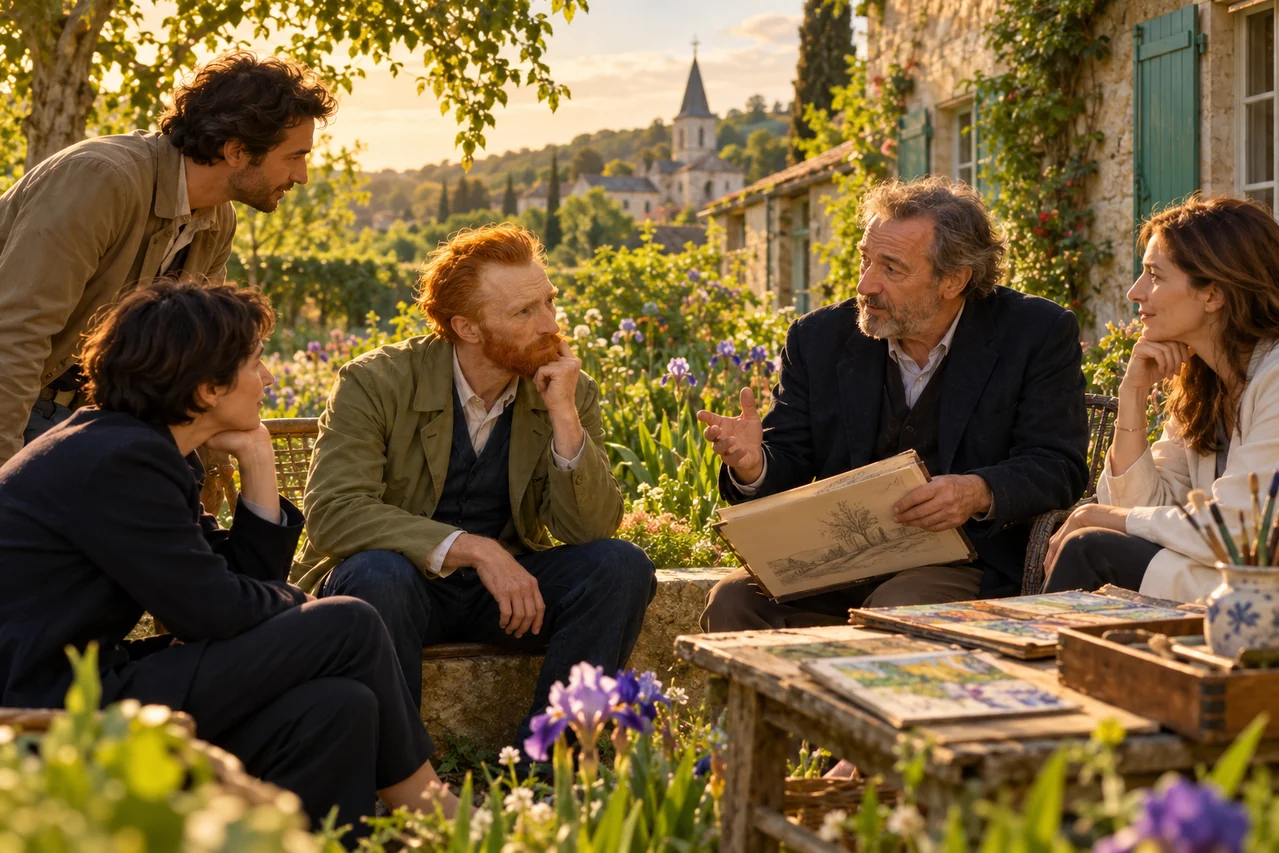
A doctor chosen within an artistic network
The move to Auvers involved discussion of Vincent's circumstances and the possibility of medical support near Paris. Gachet's connection with artists helped make him a relevant contact, with Pissarro playing a part in that network. This context matters because the arrangement was not only a clinical question. Vincent's work and interests were essential to how his needs were understood. The destination brought him into contact with someone who could engage with painting as well as with health.
Collector and artist as well as physician
Gachet's interest in art complicates a relationship often reduced to doctor and patient. He knew artists, collected work and practiced art himself. These roles gave the two men subjects and activities beyond medical supervision. They do not establish that the relationship was uncomplicated or consistently reassuring. They show why a historical account needs more than one label. Visitors can understand the significance of Gachet's presence through this overlap of professional responsibility and artistic connection.
Vincent's doubts belong within the account
The painter's responses to Gachet were not simply those of unconditional trust. Questions and reservations complicate the idea of a perfectly suited guardian. Recognizing that ambiguity does not authorize a diagnosis of either man or a confident verdict on the relationship. Letters express perceptions from particular moments. They can deepen understanding when read in context, but they should not become isolated quotations used to decide an entire history of care, friendship and artistic association.
The portraits make the relationship visible
Van Gogh's portraits of Gachet are among the most recognizable images from the Auvers period. They allow visitors to consider how a person is transformed into a painted subject through pose, color and composition. The foxglove associated with the image can prompt a discussion of the subject's medical identity, but the painting should not be read as a clinical record of the sitter. It is an artistic construction, carrying choices that exceed a straightforward illustration of Gachet's profession.
The house belongs to a wider cultural setting
A place associated with Gachet can introduce the networks around Auvers: artists, collecting and the social relationships that helped shape the village's artistic history. The advisor should distinguish its cultural role from practical access, which requires independent confirmation. The purpose is not to add an obligatory address to a checklist. It is to give guests a clearer view of the environment into which Vincent arrived and the people through whom art and daily life became connected.
Avoid retrospective medical certainty
Nineteenth-century medical understanding differed from current approaches, and the surviving material does not support casual diagnosis at a distance. Reducing Vincent to a condition, or Gachet to a doctor who should obviously have prevented everything that followed, oversimplifies the record. A careful account of Van Gogh's death keeps events and hypotheses distinct. The same restraint should govern any discussion of treatment, responsibility and the limits of what people at the time could know or accomplish.
Networks challenge the isolated-genius myth
Gachet's presence joins that of Theo and other contacts in showing that Vincent's life was not lived entirely outside social relationships. Support could be important without erasing vulnerability. The distinction helps visitors resist the idea that suffering produced the paintings or that isolation explains artistic achievement. Vincent and Theo's bond provides another essential part of this human network. Together, these accounts make room for collaboration, care and uncertainty within the story of a major artist.
Let ambiguity become a source of understanding
Gachet is compelling because he resists a neat category: doctor, friend, subject and artistic participant all illuminate part of the relationship. An Auvers Encounter can use those distinctions to open questions rather than provide an unjustified verdict. For guests interested in biography, this depth may be more rewarding than another dramatic anecdote. The human story becomes fuller when the account acknowledges overlapping roles and the limits of retrospective knowledge, then returns to the works those relationships helped place in view.
FOR YOUR GUEST ITINERARIES
For guests interested in the people behind Van Gogh's paintings, Elyrea can help make Gachet and the Auvers artistic network part of a substantive cultural itinerary.
Discuss your itinerary